


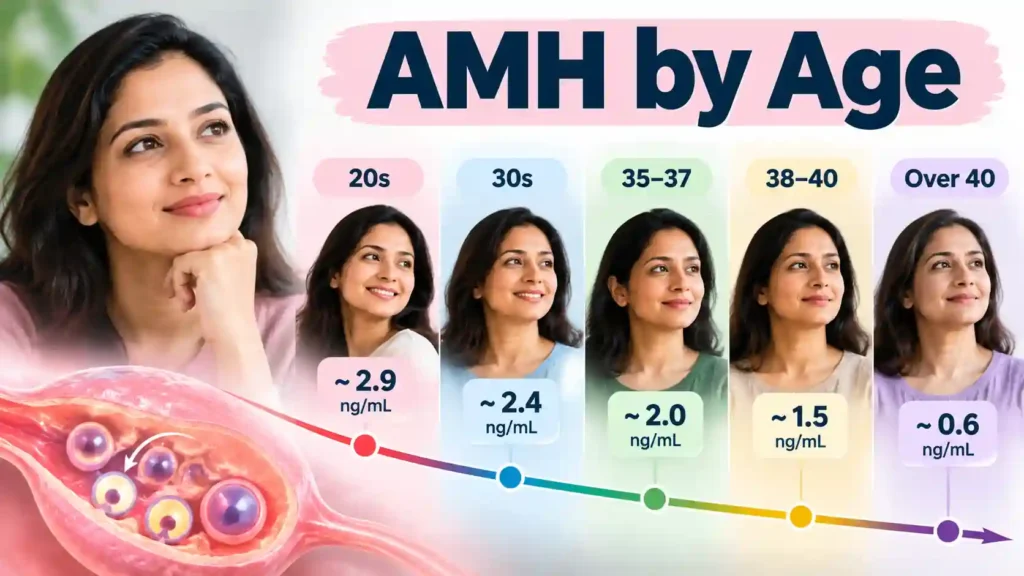
Every week, women across Bangalore bring me the same small piece of paper: an AMH report. Some arrive relieved, others already mourning a pregnancy they feel they have lost on paper. The truth sits somewhere kinder than either reaction. AMH levels by age give a snapshot of how many resting eggs your ovaries are holding, nothing more and nothing less.
The number cannot tell you whether you will conceive this year, and it cannot judge the quality of what you have. What it can do is guide timing, testing, and treatment choices, which makes it genuinely useful. After two decades in fertility practice, I can tell you that most AMH anxiety comes from reading a report without its context. Let me walk you through it the way I do in my consultation room.
Key Takeaways
- AMH is a marker of egg quantity, not egg quality. A low result does not mean infertility, as the ASRM committee opinion makes clear.
- In a study of 750 women aged 30 to 44, women with low AMH conceived at nearly identical rates to women with normal levels by 12 months, 84% versus 75%.
- Large clinic cohorts show median AMH sliding from about 2.9 ng/mL before age 30 to about 0.6 ng/mL after 42, a decline of roughly 0.2 ng/mL per year through the mid-thirties.
- Age outweighs the number. The same AMH value can mean different things at 30 and at 40.
- NICE guidance advises against using AMH to predict natural conception, so never treat one lab value as a verdict.
- Labs differ. Compare your result with your own laboratory’s AMH normal range in ng/mL before drawing any conclusion.
What Is AMH, Really?
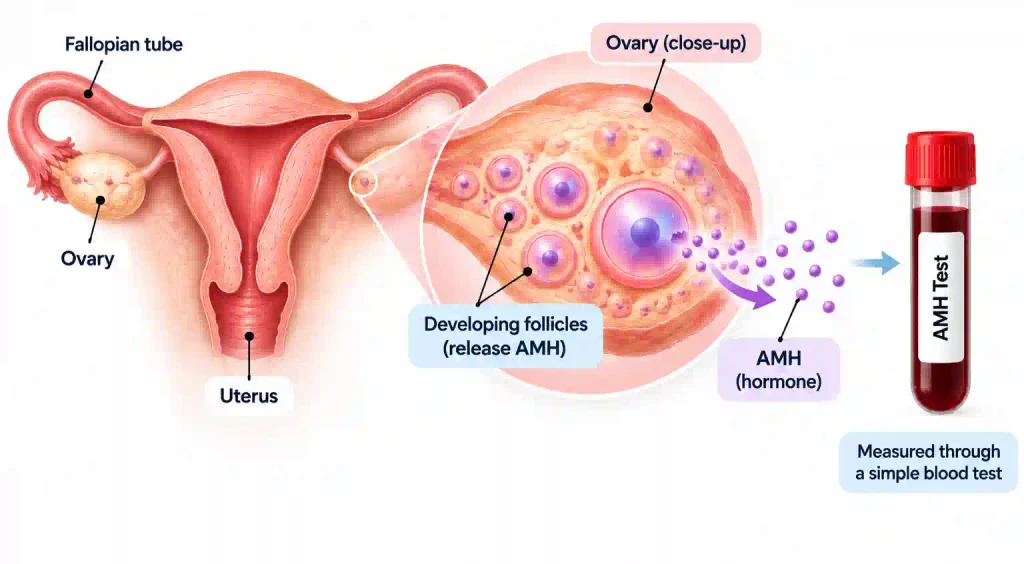
AMH stands for anti-Müllerian hormone. Small follicles in your ovaries release it, and the more resting follicles you have, the higher the reading. That is why doctors call it a reserve marker, and why the anti-Müllerian hormone test has become a standard part of fertility workups.
A simple way to picture it: AMH is a headcount, not a health check. It estimates how many candidates are waiting in the wings. It says nothing about how well any individual egg will function after fertilisation.
The test itself is a plain blood draw, and you can take it at any point in your cycle. No fasting, no special preparation, and no day-three timing the way older hormone tests required. Results usually return within a day or two in most Bangalore labs.
1. What the test can tell you:
- A rough estimate of your remaining egg pool
- How your ovaries might respond to IVF stimulation
- Whether PCOS could be part of your picture when levels run high
2. What it cannot tell you:
- The quality of your eggs
- Whether you will conceive naturally or need treatment
- Your exact time to pregnancy
“I remind every patient that AMH is a headcount, not a report card. It counts resting follicles, but it says nothing about the quality of the eggs inside them. Your age still carries more weight than any single number on the report.” Dr. Lakshmi Priya
AMH Levels by Age: The Chart Women Actually Need
Most women arrive having googled a single “normal” value, only to find three different charts quoting three different numbers. The confusion is understandable, and it is not your fault. Every chart measures something slightly different: some show averages, some show conservative lower limits, and some show a specific lab’s reference interval.
The table below shows median AMH values from a large clinic-based cohort of women without known infertility. Treat these figures as landmarks, not pass or fail lines.
| Age band | Typical median AMH (ng/mL) | What it usually reflects |
|---|---|---|
| Under 30 | about 2.9 | A generous resting pool; values above 4.0 may hint at PCOS |
| 30 to 34 | about 2.4 | The normal early slide begins; still comfortably fertile range for most |
| 35 to 37 | about 2.0 | Steady, expected decline; quality now matters more than quantity |
| 38 to 40 | about 1.5 | Lower readings are common and not automatically alarming |
| 41 to 42 | about 0.9 | Values under 1.0 are routine at this age, not a crisis |
| Over 42 | about 0.6 | Low numbers are the norm; timing decisions matter most |
Three reading rules make this chart honest:
- Under 1.0 ng/mL is commonly labelled “low”, and under 0.4 is labelled very low, but neither label means infertile.
- The same value reads differently at different ages, which is why AMH levels by age matter more than AMH alone.
- Each lab uses a different assay, so your report’s own reference range outranks any chart on the internet.
“Most women panic when they see their AMH slide a little each year, but that slide is biology, not disease. A dip from 2.4 to 2.0 between 30 and 35 is exactly what we expect. Only when a number sits far outside the age band do we look closer.” Dr. Lakshmi Priya
Your 20s: The Decade of Options
In your twenties, AMH sits at its lifetime peak, typically between 2.5 and 4.0 ng/mL. Readings vary widely between healthy women, so a 2.0 and a 4.5 can both be perfectly normal for age. If you are not planning pregnancy yet, this is the decade when an AMH fertility test helps most with planning, such as deciding whether egg freezing deserves a conversation.
A reading above 4.5 to 5.0 ng/mL at a young age sometimes signals PCOS, especially when cycles are irregular. High results deserve a review, not a celebration.
- Regular cycles plus high AMH: usually no action needed
- Irregular cycles plus high AMH: worth a PCOS check with your gynaecologist
- Low AMH in your twenties: uncommon, and worth a proper evaluation rather than a Google spiral
Your 30s: Where Numbers Start Sliding
The decline becomes visible in this decade. A normal AMH for age 30 typically sits between 2.0 and 3.0 ng/mL, while the average AMH level for age 35 drifts closer to 1.5 to 2.5. Research following more than 17,120 women found the median drop runs about 0.2 ng/mL per year through age 35, then about 0.1 after that.
If you are 35 and your reading is 1.8, you are sitting almost exactly on the cohort median. That is not a failing grade. Low AMH at 30, by contrast, stands out more, because it is genuinely early relative to peers. It still does not mean you cannot conceive, but it does argue for a fuller assessment sooner rather than later.
- Trying at 30 with low AMH: check thyroid, cycle regularity, and partner factors before anything else
- Trying at 35 to 37 with a median reading: age-appropriate, keep trying, review after 6 months
- Considering delayed pregnancy: this is the decade when timing conversations become practical
Your 40s: Age Leads, AMH Follows
At 40, median AMH falls near 1.0 ng/mL, and readings of 0.5 are ordinary. Here is the part competitors’ charts rarely say plainly: AMH at age 40 adds surprisingly little new information, because age itself already predicts a great deal. Natural pregnancy at 40 is absolutely possible, though monthly chances are lower and miscarriage risk rises.
Egg quantity keeps falling with age, and quality declines alongside it. That pairing, not the AMH value alone, drives most of what we see in clinic. Women over 40 with perfectly “average” AMH can still face age-related fertility challenges, which proves the number is only ever part of the story.
Reading Low, Normal, and High Results the Right Way
1. Low AMH Meaning in Plain Language
The low AMH meaning is straightforward: fewer resting follicles than typical for your age. That is all. It is not a diagnosis, not a verdict on motherhood, and not a countdown clock. Clinicians use it mainly to plan IVF stimulation doses and to prompt timely evaluation, not to forecast your future.
The deeper mistake women make is assuming a low number equalled poor eggs. It does not. Reserve and quality are separate axes, and age dominates the quality axis.
2. High AMH Meaning and the PCOS Link
The high AMH meaning is different from the low one. Elevated values often point to PCOS, where many small follicles produce extra hormone. High AMH can also mean your ovaries may over-respond during IVF stimulation, so your specialist will dose medications carefully. Neither scenario is a fertility bonus or a disease by itself.
- High AMH with regular cycles: usually needs nothing more than routine monitoring
- High AMH with irregular cycles: screen for PCOS
- Very high AMH before IVF: mention it, because stimulation protocols change
3. Why Two Women of the Same Age Can Differ
Genetics, smoking, body composition, prior ovarian surgery, chemotherapy, and even the lab’s assay method all shift AMH. Two 33-year-olds can read 1.2 and 3.8 and both be entirely healthy. This is exactly why AMH levels by age must always be read as bands, not as single targets.
AMH and Egg Count: What the Number Does and Does Not Predict
AMH and egg count track together reasonably well, which is why researchers trust it for estimating how many eggs an IVF cycle might retrieve. A higher reading usually predicts a better response to stimulation, and a lower reading predicts a modest one. That is genuinely useful information for planning treatment.
Pregnancy is a different question entirely. There is no single AMH level for pregnancy, and the AMH and fertility chances conversation is where most online content misleads women. A landmark JAMA study followed 750 women aged 30 to 44 who were trying to conceive naturally. Women with low AMH, under 0.7 ng/mL, had a 65% chance of conception by six cycles compared with 62% for women with normal AMH. By twelve cycles it was 84% versus 75%. Neither gap was statistically significant.
Read that twice. Low AMH did not slow natural conception in this population.
“Women often ask me whether their AMH just cancelled their chances, and the evidence says no. Among women trying naturally, those with low AMH conceived at almost the same rate as everyone else. What AMH cannot do is promise you a specific timeline, and neither can I.” Dr. Lakshmi Priya
What Is a Good AMH Level, Then?
Many women ask what is a good AMH level, and the honest answer is “one that fits your age band and your goals.” A 1.5 at 38 is good. A 1.5 at 28 invites a closer look at the whole picture. A 3.5 with irregular cycles invites a PCOS check. Context outranks the digits every single time.
Why AMH Declines, and How Fast
Declining AMH mirrors declining follicle supply, which begins before birth and accelerates through the thirties. The population average, about 0.2 ng/mL yearly until 35 and roughly half that afterwards, describes groups, not individuals. Your personal curve can differ meaningfully, so a single test never defines your trajectory.
Testing annually only helps when the result will change a decision, such as egg freezing timing or when to escalate evaluation. Otherwise, repeat testing mostly feeds anxiety. Declining AMH is expected; the pace is what deserves attention.
What to Do Next, Based on Your Age and Goals
The right response to an AMH result depends far more on your plans than on the number itself.
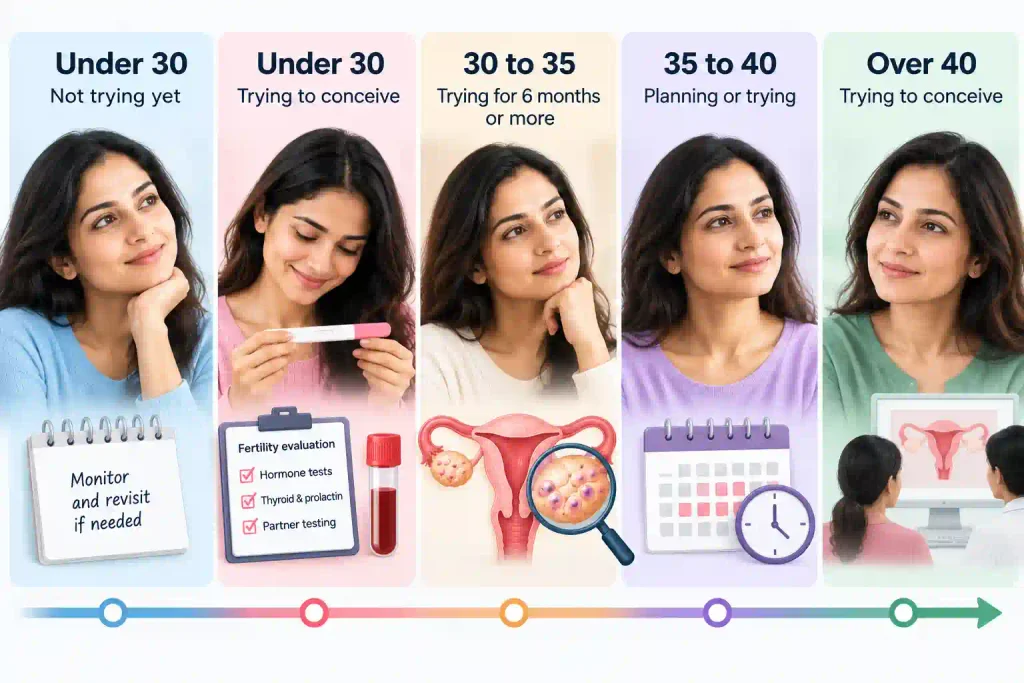
- Under 30, not trying yet: One reading is enough for now. Revisit only if cycles are irregular or family plans are far away and you want to discuss egg freezing.
- Under 30, trying: Low AMH at this age deserves a proper workup, including a comprehensive fertility evaluation, thyroid and prolactin checks, and partner testing.
- 30 to 35, trying for 6 months or more: Move to evaluation. AMH alone cannot explain delayed conception, and our fertility evaluation tools exist precisely because several tests must be read together.
- 35 to 40, planning or trying: Act a little sooner. If 6 months pass without success, seek assessment rather than waiting a full year.
- Over 40, trying: Consult a specialist early, ideally within 3 to 6 months of trying.
Treatment rarely starts with IVF. Ovulation induction and IUI help many women, and our assisted reproductive treatment explains the full ladder. When low AMH is the dominant finding, our dedicated low AMH and poor ovarian reserve resource covers the condition-specific path in depth.
“Treat AMH as one page of your story, not the whole book. When I review a report, I read it alongside your age, cycle history, and ultrasound before we discuss any next step. Very few women ever need to act on AMH alone.” Dr. Lakshmi Priya
AMH Test in Bangalore: Cost, Preparation, and Practicalities
An AMH test in Bangalore costs roughly ₹2,000 to ₹2,500 at major labs, though Apollo Diagnostics and others list prices that change with offers and home collection. Check the current rate before booking, because amh test cost figures online age quickly. Home collection is widely available, which makes testing convenient.
Preparation is simple:
- No fasting required
- Take the test at any point in your cycle
- Continue regular medications unless your doctor advises otherwise
- Note the lab’s own reference range on your report
If you are testing before trying to conceive, that is a reasonable choice at 30 and above, or whenever cycles are irregular. Just remember the test informs planning; it does not grade you.
Final Thought
An AMH report is a timing tool, not a sentence. Read it against your age band, respect the lab’s range, and remember that women with low numbers conceive naturally every single month. If your result worries you, bring it to a consultation where age, cycles, ultrasound, and your goals sit on the table together. Numbers inform decisions. They should never rob you of hope.
Frequently Asked Questions
1. What should my AMH level be for my age?
Expect roughly 2.5 to 4.0 ng/mL in your twenties, 1.5 to 3.0 in your early thirties, and 0.5 to 1.5 by your forties. These are broad medians, not cutoffs. Your lab’s own range matters more than any chart.
2. What does my AMH level actually mean for my fertility?
It estimates your remaining egg supply, which helps time decisions and plan IVF. It does not measure egg quality or predict conception. Read it with your age and cycle history, never in isolation.
3. Is AMH more important than age when assessing fertility?
No. Age outweighs AMH because egg quality declines with time, and no blood test captures that. AMH adds useful detail about quantity, but it never replaces age in counselling.
4. Can I have low AMH and still get pregnant naturally?
Yes, and research strongly supports this. In the JAMA study, women with low AMH conceived at rates similar to women with normal values within a year. Low AMH means fewer eggs in reserve, not zero fertility.
5. Does a low AMH mean I have fewer good-quality eggs?
It means fewer eggs overall, and quality is a separate matter driven mainly by age. Many women with low AMH produce good-quality eggs and healthy embryos. Quantity and quality should never be conflated.
6. Can AMH tell me how many eggs I have left?
It offers a rough estimate of the resting follicle pool, not an exact count. Ultrasound antral follicle counting adds a second view. Both together beat either test alone.
7. Why can two women of the same age have very different AMH levels?
Genetics, smoking, ovarian surgery, weight, PCOS, and lab assay differences all play a role. AMH naturally varies widely between healthy women. That variation is why age-banded charts are the honest way to read results.
8. What does a normal AMH level at 30, 35, or 40 really mean?
At 30, around 2.0 to 3.0 ng/mL is typical, at 35 closer to 1.5 to 2.5, and at 40 near 1.0. Normal means your reserve matches your age. It does not grade your fertility.
9. Is AMH 1.0, 0.5, or 2.0 considered low for my age?
Context decides. A 1.0 at 40 is unremarkable, while the same value at 29 sits below typical bands, and 0.5 is low at any age under 40. Even then, low describes quantity, not destiny.
10. Does AMH decline every year, and how quickly does it change?
Yes, the average slide runs about 0.2 ng/mL per year through 35, then about 0.1. Individual curves vary considerably. One test never defines your personal trend.
11. Can a high AMH level also be a concern?
Sometimes. Very high values often accompany PCOS, especially with irregular cycles, and they can raise over-response risk during IVF stimulation. High AMH is a reason for review, not alarm.
12. Does low AMH mean IVF is my only option?
No. Many women with low AMH conceive with timed intercourse, ovulation induction, or IUI. IVF becomes relevant when other factors exist, when time is short, or when simpler routes have not worked.
13. Can AMH predict my chances of getting pregnant naturally?
It cannot. NICE guidance advises against using AMH to predict spontaneous conception because the evidence does not support it. Natural pregnancy depends on many systems working together.
14. Should I get an AMH test if I am not trying for pregnancy yet?
It is reasonable from your late twenties if family plans are distant, since results can inform egg freezing discussions. If plans are near and cycles are regular, testing adds little. Decide based on what would change your choices.
15. Where can I get an AMH test in Bangalore, and how much does it cost?
Most major diagnostic chains across Bangalore offer it, with or without home collection. Expect roughly ₹2,000 to ₹2,500, and confirm the current price when booking. Bring the report to a fertility consultation rather than interpreting it alone.