



If your AMH report shows a number like 0.9, 0.6, or even lower, the first feeling is often fear. Many women walk into my clinic holding that single value, convinced their chance of motherhood has ended. It has not. What low AMH actually changes is the strategy, and that is exactly what a well-planned low AMH IVF treatment in Bangalore should address.
Key Takeaways
- Low AMH means fewer eggs per IVF cycle, not a closed door. It predicts egg count far better than pregnancy outcome, and it is best read alongside your age, ultrasound, and hormone tests.
- Mild stimulation compares well with high-dose IVF for poor responders. A large trial found similar clinical pregnancy rates with about 3,100 IU less medication and 1.3 fewer days of injections.
- With extremely low AMH (below 0.16 ng/mL), live birth was 9.5% per cycle start in a national review of over 5,000 cycles, and 1 in 4 cycles produced no embryo for transfer.
- DuoStim and embryo banking can shorten the journey to enough embryos for one good transfer.
- Typical IVF cost in Bangalore runs about ₹1.4 to 2.8 lakh per cycle, and gentler protocols often cut the medicine bill.
- Age influences live birth more than AMH does. Your plan should target cumulative success across cycles, not one perfect attempt.
- Any sound low AMH IVF treatment in Bangalore plan starts with a full fertility evaluation, not with the AMH number alone.
What Low AMH Actually Means
AMH (anti-Müllerian hormone) is released by small resting follicles in your ovaries. A low level suggests a smaller remaining egg pool. Most labs call anything below about 1.1 ng/mL low, and some use 1.2 as the cutoff.
What AMH does not tell you matters just as much.
- It does not predict egg quality on its own. Your age matters far more for that.
- It does not equal pregnancy odds. Many women with low AMH conceive with their own eggs.
- It fluctuates less across cycles than FSH, but no single test defines your reserve.
“AMH tells me how many eggs I can expect in a cycle, not whether those eggs can become your baby. I have seen women with very low AMH carry a pregnancy, and women with normal AMH need several attempts. The number shapes the plan, not the outcome.” — Dr. Lakshmi Priya
A meaningful reserve picture always combines AMH with antral follicle count on ultrasound, age, cycle history, and prior response to medicines, as covered in low AMH and poor ovarian reserve.
How Low AMH Changes the IVF Plan
With a healthy egg pool, IVF protocols aim to recruit many follicles at once. With low AMH, that math breaks down, so the strategy shifts in three ways.
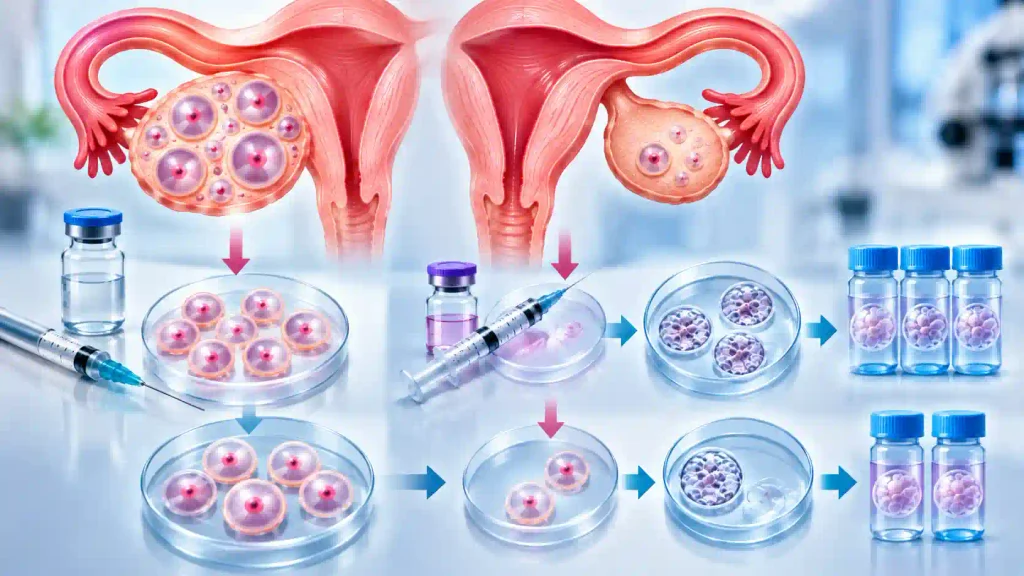
- Protecting every egg. Each retrieved egg carries more weight, so lab handling, fertilization method, and timing get extra attention.
- Rethinking drug doses. Pushing gonadotropin doses ever higher rarely recruits more follicles in a low-reserve ovary. Research summarized in the ESHRE guidelines supports tailoring stimulation to the person instead of one fixed recipe.
- Thinking in cycles, not cycles. One retrieval may not produce enough embryos, so banking across two or three cycles becomes part of the conversation.
Which IVF Protocol Fits Low AMH Best
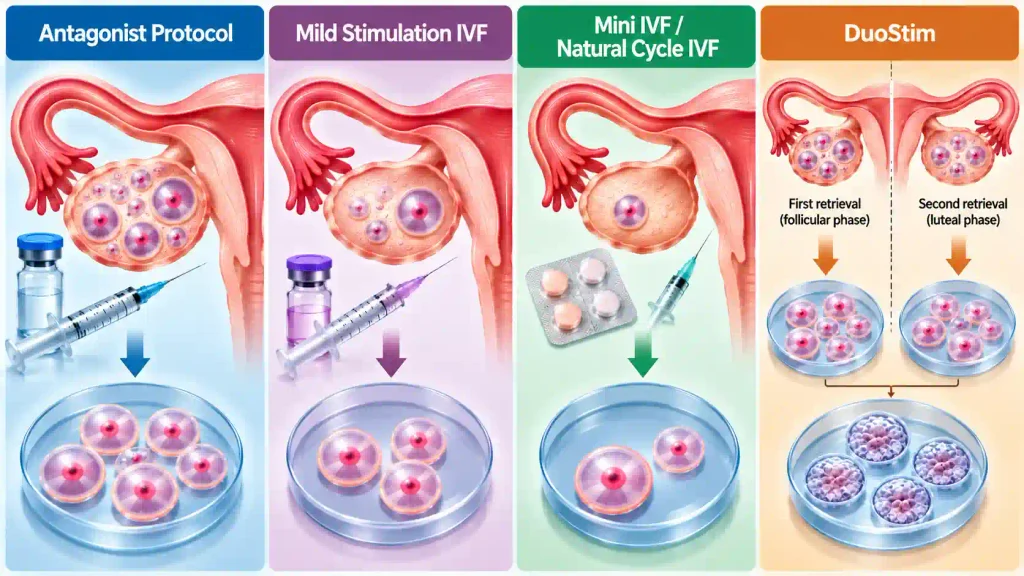
There is no single “best” protocol, only the best fit for your age, follicle count, and history. These are the four approaches most often considered for IVF for diminished ovarian reserve.
1. Antagonist Protocol
The antagonist protocol is the workhorse for predicted low responders. It uses injections with a second medicine that prevents early ovulation, and it gives flexibility to adjust doses mid-cycle. Most low AMH IVF treatment in Bangalore plans still start here because it is well studied and adaptable.
2. Mild Stimulation IVF
Mild stimulation uses lower injection doses, often starting with 150 IU rather than 300 to 450 IU. The trade-off is fewer eggs, but the outcomes tell a more balanced story. A randomized trial summarized by ASRM found nearly identical clinical pregnancy rates, 15.3% versus 15.5%, with far less medication and about 1.3 fewer days of stimulation.
“A smaller dose is not a smaller effort. For many women with low AMH, a gentler protocol offers similar pregnancy chances with fewer injections and a lower medicine bill. What matters is the number of good embryos we collect over time.” — Dr. Lakshmi Priya
3. Mini IVF and Natural Cycle IVF
Mini IVF (low AMH-friendly by design) combines oral tablets like letrozole or clomiphene with low-dose injections. Natural cycle IVF uses almost no medicine and retrieves the one or two eggs your body produces anyway. Both cost less per cycle and carry a higher risk of cancellation, which is why they pair naturally with embryo banking.
4. DuoStim
The DuoStim protocol retrieves eggs twice within one menstrual cycle, once in the follicular phase and again in the luteal phase. A multicentre study of poor-prognosis patients showed this approach can collect more eggs in a single month. It suits women with very low AMH who want to compress two retrievals into one calendar month, often before age-related decline advances.
Protocol Comparison at a Glance
| Protocol | Who it suits | Typical trade-off |
|---|---|---|
| Conventional antagonist | Most low responders | More injections, higher medicine cost |
| Mild stimulation | Women wanting fewer drugs and lower cost | Fewer eggs, slightly higher cancellation risk |
| Mini IVF / natural cycle | Very low AMH, cost-sensitive, cancer or risk cases | Usually 1 to 3 eggs, banking usually needed |
| DuoStim | Time-pressed women wanting more eggs per month | Two procedures in one cycle, higher monitoring load |
Embryo Banking: Building Numbers Over Cycles
Embryo banking means freezing embryos from more than one retrieval instead of transferring after each one. The logic is simple. With low AMH, a single cycle may yield one or two embryos, and a single embryo transfer may not succeed. Pooling embryos across cycles raises the odds that at least one good blastocyst is available for transfer.
Banking is worth discussing when AMH is very low, when mini IVF is chosen, or when you want to preserve options before age reduces quality further. The cost is time and money spread across cycles, and it deserves an honest conversation about how many IVF cycles you may realistically need, often two or three for enough embryos.
How Many Eggs Can You Expect With Low AMH?
Exact numbers vary with age and follicle count, but realistic ranges help. Women with low AMH typically retrieve around 2 to 6 eggs per stimulated cycle, and mini IVF may yield only 1 to 3.
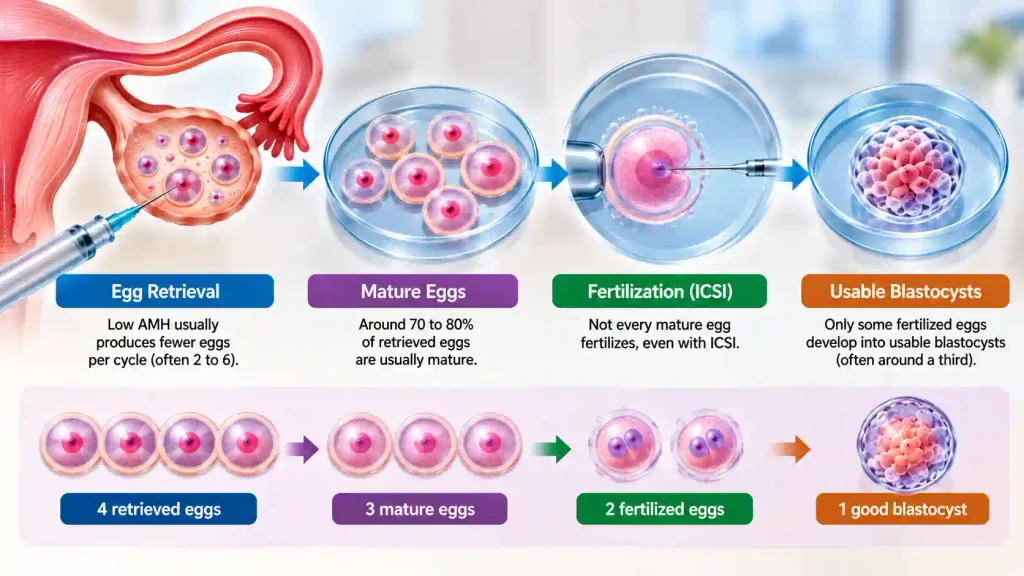
Then attrition happens at every step.
- Not every egg is mature. Perhaps 70 to 80% usually are.
- Not every mature egg fertilizes, even with ICSI.
- Only some fertilized eggs become usable blastocysts, often around a third.
So 4 eggs may become 3 mature, 2 fertilized, and 1 good blastocyst. That is a normal outcome with low reserve, not a failure. It is also why protocols aim to bank across cycles. More detail on what this means for your situation is in our fertility care hub.
IVF Success Rate With Low AMH
Honest numbers beat comforting ones. In the ASRM review of cycles with AMH below 0.16 ng/mL, 54% of cycles were cancelled and live birth was 9.5% per cycle start. With low but not extreme AMH, chances climb, and age is the stronger driver of live birth.
The POSEIDON framework groups low-prognosis patients by age, AMH, and follicle count, precisely because a 32-year-old with AMH 0.8 and a 39-year-old with AMH 0.8 have very different prospects. IVF with own eggs at low AMH remains a reasonable first choice for many women under 35, while donor-egg conversations should be raised gently and only when the numbers genuinely support it.
“With low AMH, we are often racing time rather than chasing one perfect cycle. Banking embryos across two or three retrievals turns a few eggs each month into a real, cumulative chance.” — Dr. Lakshmi Priya
How Much Does Low AMH IVF Treatment in Bangalore Cost?
Costs vary by clinic, protocol, and how many cycles you need. Recent estimates place IVF in Bangalore at roughly ₹1.4 to 2.8 lakh per cycle, with basic packages starting near ₹1 lakh and advanced ICSI cycles from about ₹1.8 lakh (Bangalore cost guide).
- Stimulation medicines: often ₹20,000 to ₹60,000, and mild or mini IVF usually sits at the lower end.
- Monitoring scans and blood tests: usually billed separately from package prices.
- Freezing and annual storage: relevant if embryo banking is planned.
- Frozen embryo transfer: an additional cycle cost if embryos are banked first.
Ask for an itemized quote, including what happens if a cycle is cancelled. A transparent low AMH IVF treatment in Bangalore quote should list medicines, monitoring, retrieval, lab work, and transfer as separate lines. Our IVF treatment explains the process step by step, and couples considering gentler first steps can also read about IUI treatment.
Questions to Ask Before You Choose a Protocol
- Based on my age, AMH, and follicle count, how many eggs do you expect per cycle?
- Would mild stimulation, DuoStim, or conventional dosing suit me, and why?
- Do you recommend banking embryos across cycles before a transfer?
- What is my cumulative chance over two or three cycles, not just one?
- What does an itemized cycle cost include, and what if the cycle is cancelled?
- Which add-ons do you avoid unless there is clear evidence?
- At what point would you suggest discussing donor eggs, and how is that decided?
Final Thoughts
Low AMH rewrites the IVF plan, not the destination. Fewer eggs per cycle means protocols get smarter, doses get gentler, and embryos get banked with intention. Age, follicle count, and how many embryos you can accumulate matter more than the AMH digit on the report. If you are weighing low AMH IVF treatment in Bangalore, start with a clinic that explains egg math honestly, quotes costs openly, and measures success cumulatively. Book a consultation, bring your reports, and ask the hard questions above. The right plan is the one built around your numbers and your timeline.
Frequently Asked Questions
1. Can you have a good IVF outcome with low AMH?
Yes, especially when age is favorable and enough embryos are banked across cycles. Low AMH lowers the number of eggs per cycle more than it lowers the chance per good embryo transferred. Cumulative success over two or three cycles is the fairer way to judge.
2. What IVF protocol is usually considered for low AMH and diminished ovarian reserve?
The antagonist protocol is the usual starting point because doses can be adjusted flexibly. Mild stimulation and mini IVF are common alternatives when you want fewer injections or lower cost. DuoStim is considered when collecting more eggs in a single month matters.
3. Is mild stimulation IVF better than conventional IVF for low AMH?
Trials show similar clinical pregnancy rates with lower doses, fewer injections, and less expense, though fewer eggs are retrieved. For many low-reserve patients, that trade is worthwhile. The right choice depends on your age, follicle count, and how many cycles you can commit to.
4. Is mini IVF a good option when AMH is very low?
Mini IVF can suit very low AMH because high doses rarely recruit many follicles anyway. It costs less per cycle and feels gentler, but expect 1 to 3 eggs and a real chance of cancellation. It usually works best combined with embryo banking.
5. How many eggs can you expect from IVF with low AMH?
Most women with low AMH retrieve around 2 to 6 eggs per stimulated cycle, and mini IVF often yields 1 to 3. Age and antral follicle count refine that estimate. A realistic plan assumes attrition at fertilization and blastocyst stages.
6. Does using higher doses of IVF stimulation drugs improve egg numbers with low AMH?
Beyond a certain point, no. When the resting follicle pool is small, extra gonadotropins mainly add cost and injections without adding eggs. Trials in poor responders found comparable pregnancy rates with roughly a third less medication.
7. What is the antagonist protocol in IVF, and is it suitable for low AMH?
It is a stimulation plan using a daily antagonist injection to prevent premature ovulation, which protects the few follicles you have. It suits low AMH well because doses are adjustable and cycle length is shorter than older agonist protocols. Most clinics consider it the default first option.
8. What is DuoStim, and when might it be considered for low AMH?
DuoStim means stimulating and retrieving eggs twice within one menstrual cycle. It may be considered when AMH is very low, time matters, or one retrieval is unlikely to produce enough embryos. Studies in poor-prognosis patients show it can collect more eggs per month.
9. Can DuoStim help increase the number of eggs or embryos collected in a shorter time?
Yes, that is its main purpose, essentially running two retrievals in one calendar month. It may collect more oocytes than a single stimulation in selected patients. The trade-off is heavier monitoring and two procedures, so costs and recovery need discussion.
10. What does embryo banking mean, and why might it be considered with low AMH?
Embryo banking means freezing embryos from several retrievals and transferring later from the pooled group. With low AMH, each cycle yields few embryos, so pooling raises the chance that at least one quality blastocyst is available. It spreads cost over time but improves cumulative odds.
11. How many IVF cycles may be needed when you have low AMH?
Many women need two or three retrievals to bank enough embryos for one to two transfers. There is no fixed number, since age, protocol, and lab results all influence it. Judging success per cycle start alone underestimates your real cumulative chance.
12. Can you do IVF with your own eggs when AMH is very low?
Often yes, particularly below age 35 or when follicle count is still reasonable. Very low AMH with advanced age makes own-egg success less likely, and that conversation deserves honesty rather than fear. A trial cycle with banking is sometimes the most informative option.
13. What is the IVF success rate with low AMH, and does age matter more than AMH?
For extremely low AMH, live birth is about 9.5% per cycle start, rising substantially with less severe reductions. Age drives live birth more than AMH because it governs egg quality. A 33-year-old with low AMH usually has better odds than a 40-year-old with the same value.
14. How much does low AMH IVF treatment cost in Bangalore?
Expect roughly ₹1.4 to 2.8 lakh per cycle, with medicines adding ₹20,000 to ₹60,000. Mild and mini IVF lower the medicine bill, while banking adds freezing and storage charges. Insist on an itemized quote covering cancellation scenarios.
15. What should you ask your fertility specialist before choosing a low AMH IVF protocol?
Ask how many eggs and embryos they realistically expect for you, and why a specific protocol fits your profile. Ask about cumulative success across cycles, banking strategy, and itemized costs including cancellation. Also ask which unproven add-ons they avoid.