

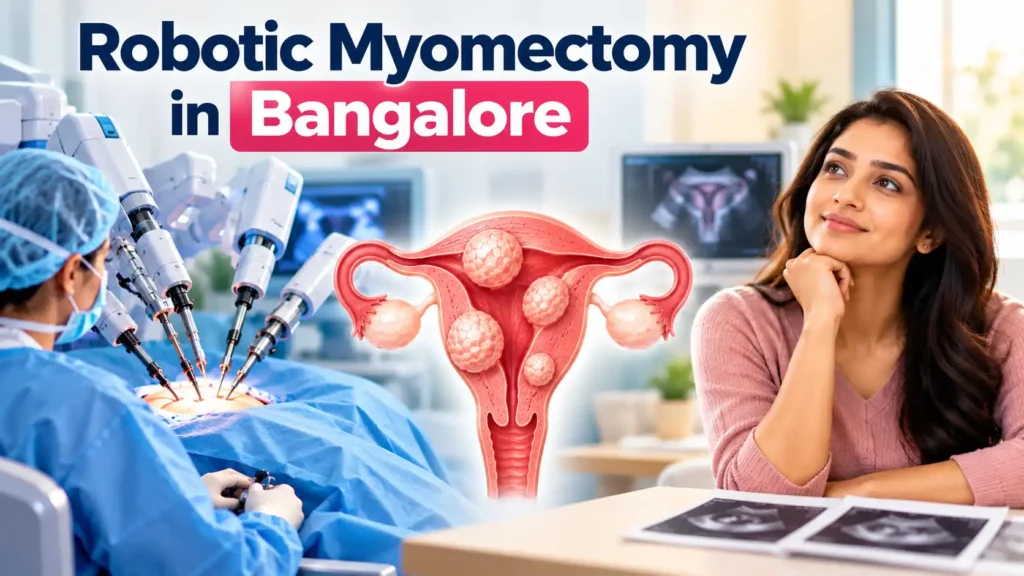
You have fibroids. You want a baby. And now you have to choose a surgery. Open, keyhole or robotic? Each one sounds good on paper, and each clinic seems to say its option is best.
If you are looking into robotic myomectomy in Bangalore, the real question is simple. Which surgery gives you the best chance of a safe pregnancy later? The honest answer depends on your fibroids, not on the machine. Below, you will see how each option compares in plain words.
Key Takeaways
- A myomectomy removes fibroids and keeps the womb, so you can still get pregnant.
- Compared with open surgery, robotic myomectomy leads to less blood loss, fewer transfusions and a shorter hospital stay, though the operation takes longer.
- Compared with standard keyhole surgery, robotic surgery shows similar complication rates. One study found it took about 77 minutes longer on average.
- A 2024 review of 32 studies and 6,357 patients found robotic surgery safer than open surgery, while standard keyhole surgery did as well or better overall.
- After robotic myomectomy, scar tissue was found in about 11.4% of women at a later C-section. Older reports suggest higher rates after keyhole and open surgery.
- The risk of the womb tearing in a later pregnancy is low: about 0.79% overall, 1.2% after keyhole and 0.4% after open surgery. The difference was not statistically significant.
- Recovery takes about 2 to 4 weeks after keyhole surgery and up to 6 weeks after open surgery.
What Is a Myomectomy?
A myomectomy is surgery to take out fibroids while keeping your womb. It is the main surgery for women who still want children. A hysterectomy removes the whole womb, so pregnancy is no longer possible.
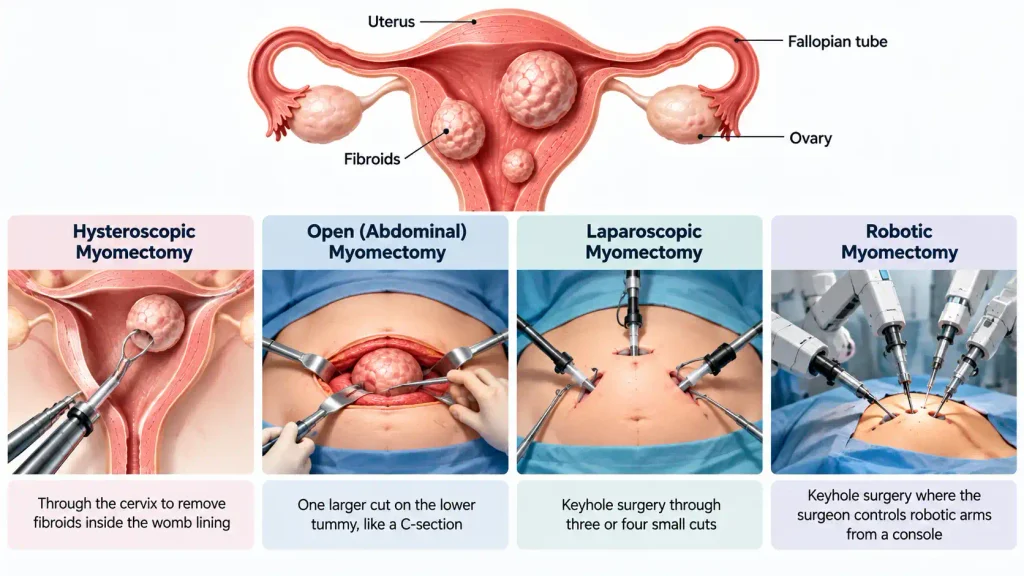
The fibroid surgery options fall into four groups:
- Hysteroscopic myomectomy: a thin camera goes in through the cervix to remove fibroids inside the womb lining. No cuts on the skin.
- Open (abdominal) myomectomy: one larger cut on the lower tummy, much like a C-section.
- Laparoscopic myomectomy: keyhole fibroid surgery through three or four small cuts.
- Robotic myomectomy: keyhole surgery where the surgeon controls robotic arms from a console.
Hysteroscopy is best for fibroids inside the cavity. The rest of this page looks at fibroids in or on the womb wall, where the choice is between open, keyhole and robotic surgery.
How Robotic Surgery for Fibroids Works
Many women picture a robot doing the work on its own. That is not how robotic myomectomy in Bangalore, or anywhere else, works. The surgeon still does the operation. The surgeon sits at a console a few feet away and moves the robotic arms with hand controls.
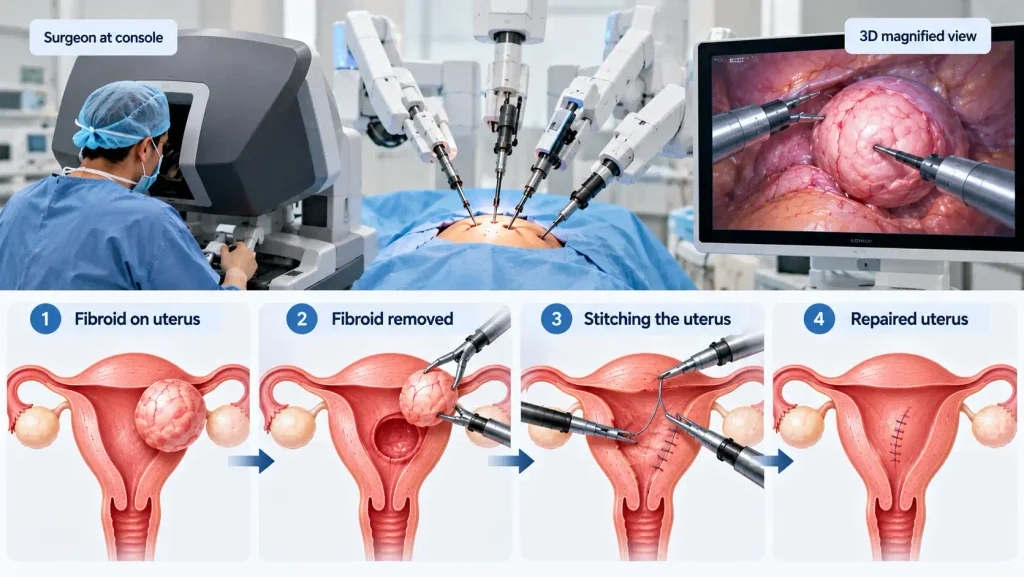
The system helps in a few key ways:
- 3D, magnified view of the womb and nearby organs
- Wristed tools that bend and turn more like a human hand
- Steady movement, with no hand tremor
- Easier deep stitching, which matters a lot when you plan a pregnancy
That last point is the heart of the fertility question. When a fibroid comes out, it leaves a gap in the womb wall. How well that gap is closed affects how strong the scar will be in pregnancy.
“A myomectomy is really two operations. The first is taking the fibroid out. The second, which matters more for your future baby, is rebuilding the womb wall in neat, strong layers.” Dr. Lakshmi Priya
Robotic vs Laparoscopic vs Open Myomectomy: A Side-by-Side Look
This is the comparison most patients ask for. It is based on published studies and what is seen in daily practice.
| Feature | Open (Abdominal) | Laparoscopic (Keyhole) | Robotic |
|---|---|---|---|
| Cuts on the skin | One cut, about 10 to 15 cm | 3 to 4 small cuts | 4 to 5 small cuts |
| Hospital stay | 2 to 4 days | Often 1 day | Often 1 day |
| Back to normal life | Up to 6 weeks | 2 to 4 weeks | 2 to 4 weeks |
| Blood loss | Highest | Low | Low |
| Operation time | Shorter | Medium | Longest |
| Deep stitching of the womb wall | Very good | Depends a lot on surgeon skill | Easier for the surgeon |
| Large or many fibroids | Best suited | Can be hard | Often possible |
| Scar tissue (adhesions) | Highest | Medium | May be lower |
| Proven better pregnancy rates | No | No | No |
| Cost | Lowest | Medium | Highest |
What the Table Really Means
Look at the row on pregnancy rates. No surgery type has clearly proven better pregnancy rates than the others. What matters most is:
- The type, size and place of each fibroid
- How well the womb wall is repaired
- Whether the womb lining is protected
- How much scar tissue forms around the tubes and ovaries
- The skill and experience of your surgeon
Does Robotic Myomectomy Improve Fertility?
Not directly. Robotic surgery does not make your eggs better or your womb more fertile. Its value is in how it helps the surgeon work.
1. Where Robotic Surgery Can Help
- Complex cases: many fibroids, deep fibroids or fibroids in hard-to-reach spots. Without the robot, some of these would need open surgery.
- Layered stitching: wristed tools make it easier to close deep gaps in more than one layer.
- Less scar tissue: a gentler keyhole approach may mean fewer adhesions near the tubes. That can help with natural conception.
- Faster healing: a shorter stay and quicker return to normal life than open surgery.
2. Where Robotic Surgery Adds Little
- A single small fibroid on the outside of the womb
- Fibroids inside the cavity, which are best removed by hysteroscopy
- Cases where a skilled keyhole surgeon can do the same job well
For many women, the real gain is this: robotic surgery can turn an open operation into a keyhole one. That means less pain, less blood loss and a faster return to trying for a baby.
“I do not suggest robotic surgery for every fibroid. For a simple fibroid, standard keyhole surgery works just as well. The robot earns its place when the fibroids are many, deep or awkward, and the only other option would be a large cut.” Dr. Lakshmi Priya
When Is Open Myomectomy the Better Choice?
Open surgery still has a clear role. It may be safer when:
- The womb is very large, beyond the size of a five-month pregnancy
- There are a great many fibroids, sometimes ten or more
- Fibroids are very large or spread through the whole wall
- There is heavy scarring from past surgery
- Robotic or keyhole skills are not available
With open surgery, the surgeon can feel the womb by hand. This helps find small hidden fibroids that a camera may miss.
Myomectomy vs Hysterectomy for Fertility
If you want to keep the chance of pregnancy, a myomectomy is the right choice. A hysterectomy ends periods and pregnancy for good. Our page on hysterectomy explains when it may be right for women who have finished their family.
Pregnancy After Myomectomy: What to Expect
1. How Long to Wait Before Trying
Most women are advised to wait 3 to 6 months before trying to conceive. Deep fibroids, or a cavity that was opened, may need a longer wait. This gives the scar time to grow strong.
A preconception counselling visit before you start trying can help plan timing, scans and any IVF needs.
2. Myomectomy Scar and Pregnancy
A myomectomy scar is usually strong. The risk of it tearing in pregnancy is low, at about 0.79% across all methods, according to a large review. But the risk is real, so your care team needs to know about your surgery.
Your doctor may suggest a planned C-section if:
- The fibroid was deep in the wall
- The womb cavity was opened during surgery
- Many fibroids were removed from the wall
3. Myomectomy Success Rate for Pregnancy
Success rates vary a lot between studies. They depend on your age, egg reserve, partner’s sperm and why you had fibroids removed. Many women conceive naturally after surgery. Others need IUI or IVF, especially if age or other fertility factors are involved.
Removing fibroids that press on the cavity helps the most. Removing small fibroids on the outside of the womb rarely changes fertility.
Recovery After Robotic Myomectomy
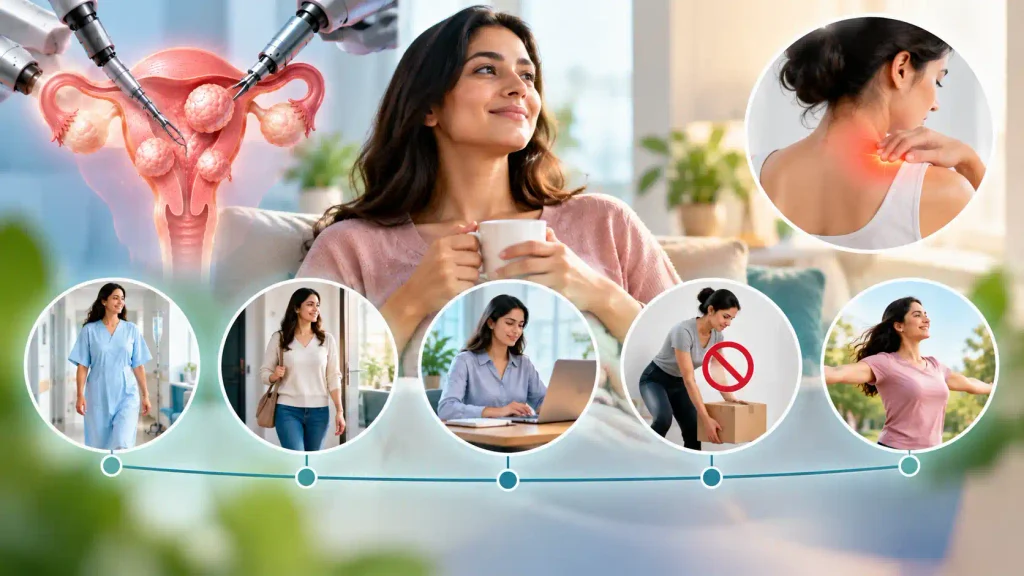
Recovery is usually quick. After robotic myomectomy in Bangalore, most women:
- Walk the same day as surgery
- Go home in about a day
- Return to desk work in 1 to 2 weeks
- Avoid heavy lifting for 4 to 6 weeks
- Feel fully back to normal in 2 to 4 weeks
You may have some shoulder pain from the gas used in keyhole surgery. It fades in a day or two.
Risks of Robotic Myomectomy
All surgery has risks. With robotic myomectomy, they include:
- Bleeding, which sometimes needs a blood transfusion
- Infection at the cut sites
- Injury to the bowel or bladder, which is rare
- A longer time under anaesthesia
- A switch to open surgery if needed for safety
- New fibroids growing in the future
The best way to lower these risks is careful planning. That means a good MRI or ultrasound map before surgery and a surgeon trained in this method.
How Robotic Myomectomy in Bangalore Is Planned
Every surgery is planned for your body and your goals. The usual steps include:
- Fibroid mapping: an ultrasound or MRI to see the size, number and place of each fibroid
- Fertility check: egg reserve tests and a review of your partner’s results, if you are trying to conceive
- Choice of method: hysteroscopic, keyhole, robotic or open, based on your fibroids
- Blood check: fixing low iron before surgery to cut the need for transfusion
- After-surgery plan: clear advice on rest, waiting time and when to try for a baby
You can read more about the full range of fibroid management surgery and laparoscopic gynaecological surgery on our site.
“My goal is not to use the most advanced tool. It is to choose the safest path to a healthy pregnancy for you. Sometimes that is the robot, sometimes keyhole surgery, and now and then an open operation.” Dr. Lakshmi Priya
Questions to Ask Before You Choose Surgery
Before you agree to robotic myomectomy in Bangalore, ask your surgeon:
- How many fibroids do I have, and where are they?
- Why is this method best for me?
- How many of these surgeries have you done?
- Will the womb cavity be opened?
- How will you repair the womb wall?
- How long should I wait before trying for a baby?
- Will I need a C-section in future?
- What is the full cost, and does my insurance cover it?
Final Thought
Robotic surgery is a useful tool, not a magic one. It shines in complex cases where it can spare you a large cut. For simple fibroids, standard keyhole surgery may serve you just as well.
The right choice for robotic myomectomy in Bangalore comes from a clear map of your fibroids, an honest talk about your fertility and a surgeon who can offer all options. If fibroids are standing between you and your plans for a family, book a consultation with Dr. Lakshmi Priya to talk through your scan and your choices.
Frequently Asked Questions
1. Does robotic myomectomy improve fertility compared with open myomectomy?
Robotic surgery has not been proven to raise pregnancy rates over open surgery. Its main gains are less blood loss, a shorter hospital stay and possibly less scar tissue. These can help you recover faster and may help natural conception.
2. Is robotic myomectomy a good option if I want to get pregnant after fibroid removal?
Yes, for many women it is a good option. It is most useful when fibroids are many, deep or hard to reach, and the other choice would be open surgery. If you are weighing robotic myomectomy in Bangalore, ask your surgeon to explain why it suits your fibroids.
3. Robotic vs laparoscopic myomectomy: Which is better for fertility?
Studies show similar results for both when done by skilled surgeons. Robotic surgery makes deep stitching easier, which helps in complex cases. For simple fibroids, standard keyhole surgery works just as well and costs less.
4. When is open myomectomy better than robotic or laparoscopic surgery?
Open surgery may be safer for a very large womb, a great many fibroids or heavy scarring from past surgery. It also lets the surgeon feel for small hidden fibroids. Your surgeon will advise based on your scan.
5. What is the best surgery for fibroids when future pregnancy is a priority?
The best surgery depends on where your fibroids are. Fibroids inside the cavity are best removed by hysteroscopy. Fibroids in the wall need keyhole, robotic or open surgery, chosen to give the strongest repair.
6. Can robotic myomectomy safely remove large or multiple fibroids?
Yes, in many cases it can. The robot’s wristed tools help with removing several fibroids and repairing the wall well. Very large wombs or a great many fibroids may still need open surgery.
7. How long after robotic myomectomy can I try to get pregnant?
Most women wait 3 to 6 months. A longer wait may be advised if fibroids were deep or the cavity was opened. Your surgeon will guide you based on what was done.
8. Can a myomectomy scar affect pregnancy or delivery?
The scar is usually strong, and the risk of it tearing is low at under 1%. Even so, your doctor may suggest a planned C-section if the fibroids were deep. Always tell your obstetrician about your past myomectomy.
9. What is the success rate of pregnancy after myomectomy?
It varies with age, egg reserve and the type of fibroids removed. Many women conceive naturally after surgery, while others need IUI or IVF. Removing fibroids that press on the cavity helps the most.
10. How long does it take to recover after robotic myomectomy?
Most women go home in about a day and return to desk work in 1 to 2 weeks. Full recovery takes about 2 to 4 weeks. Heavy lifting should wait 4 to 6 weeks.
11. Is robotic myomectomy suitable for every type and location of fibroid?
No. Fibroids inside the cavity are better treated by hysteroscopy. Very large or very many fibroids may need open surgery, while robotic surgery suits most fibroids in or on the wall.
12. What are the risks of robotic myomectomy for women planning pregnancy?
Risks include bleeding, infection, rare organ injury and new fibroids in future. In pregnancy, there is a small risk of the scar tearing. Careful repair and the right waiting time help lower these risks.
13. How much does robotic myomectomy cost in Bangalore?
Robotic myomectomy costs more than open or standard keyhole surgery because of the robot’s equipment fees. The total depends on the hospital, room type, fibroid count and insurance. Ask for a written estimate before you decide.
14. Myomectomy vs hysterectomy: Which is better if I want to preserve fertility?
A myomectomy is the right choice if you want to get pregnant. It removes the fibroids and keeps the womb. A hysterectomy removes the womb, so pregnancy is no longer possible.
15. What should I ask my doctor before choosing robotic myomectomy in Bangalore?
Ask why robotic surgery suits your fibroids and how many such surgeries the surgeon has done. Also ask how the womb wall will be repaired, how long to wait before pregnancy and the full cost. Clear answers help you make a calm, informed choice.