



You did a routine blood test, the report said “low AMH,” and now every search result is telling you something different. Some pages promise miracle pregnancies. Others quietly suggest donor eggs. If you are worrying about a low AMH pregnancy, the honest answer sits between those extremes, and it depends far more on your age, your cycles, and your timeline than on one number.
Key Takeaways
- Low AMH reflects egg count, not whether you can conceive. Cleveland Clinic states plainly that the AMH test does not predict natural fertility.
- A study of 750 women aged 30 to 44, those with low AMH had an 84 percent chance of conceiving within 12 cycles, slightly higher than the 75 percent seen in women with normal AMH.
- Women with diminished ovarian reserve can still get pregnant, though it may take longer.
- Age matters more than AMH for natural conception. Fertility declines faster after 35, so waiting is riskier than the AMH number itself.
- Standard timing still applies: test and evaluate after 12 months of trying under 35, or after 6 months at 35 and older.
What Low AMH Actually Means
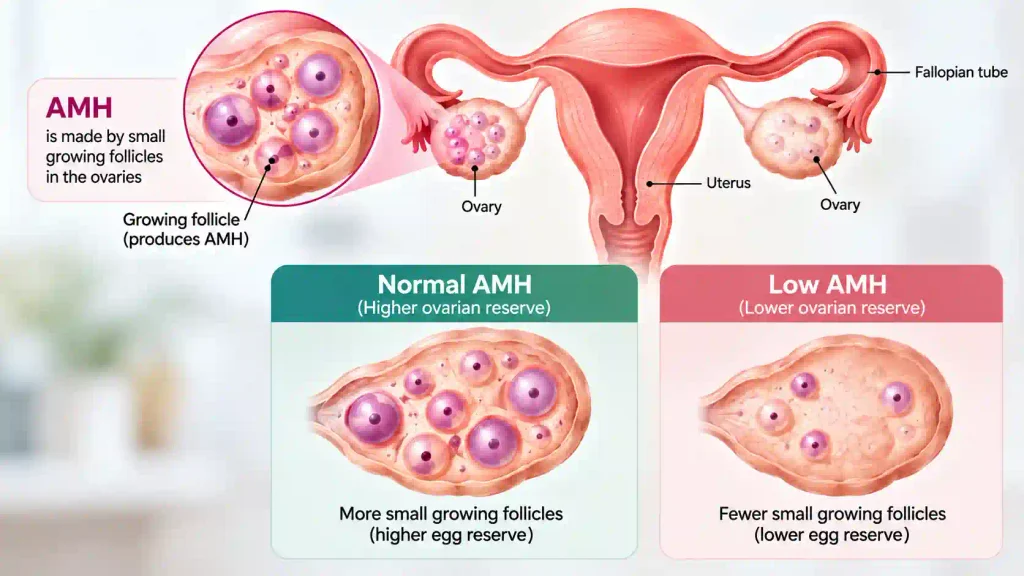
AMH, or anti-Mullerian hormone, is made by small growing follicles in your ovaries. A low level usually means fewer eggs remain in reserve. Cleveland Clinic considers levels under 1.0 ng/mL low, and below 0.4 ng/mL severely low, though every lab uses slightly different ranges.
What AMH does not tell you is just as important. It cannot predict whether you will conceive this year, whether your eggs are healthy, or when menopause will arrive. It is a count of candidates, not a verdict on the race.
“AMH tells me roughly how many eggs are left, not whether those eggs will become a baby. I have seen women with very low readings conceive on their own, and women with perfectly normal readings need IVF.” — Dr. Lakshmi Priya
Can You Get Pregnant Naturally with Low AMH?
Yes, and the best evidence comes from women who were never even fertility patients. A 2017 study followed women with low AMH (under 0.7 ng/mL) who were trying without treatment. Their monthly chance of conception matched that of women with normal AMH, and 84 percent conceived within 12 cycles.
So why do so many women hear that natural pregnancy is off the table? Partly because low AMH correlates with age, and age brings the real decline. Partly because some clinics use the number to push treatment early. The number on your report is a starting point for a conversation, not a diagnosis of infertility.
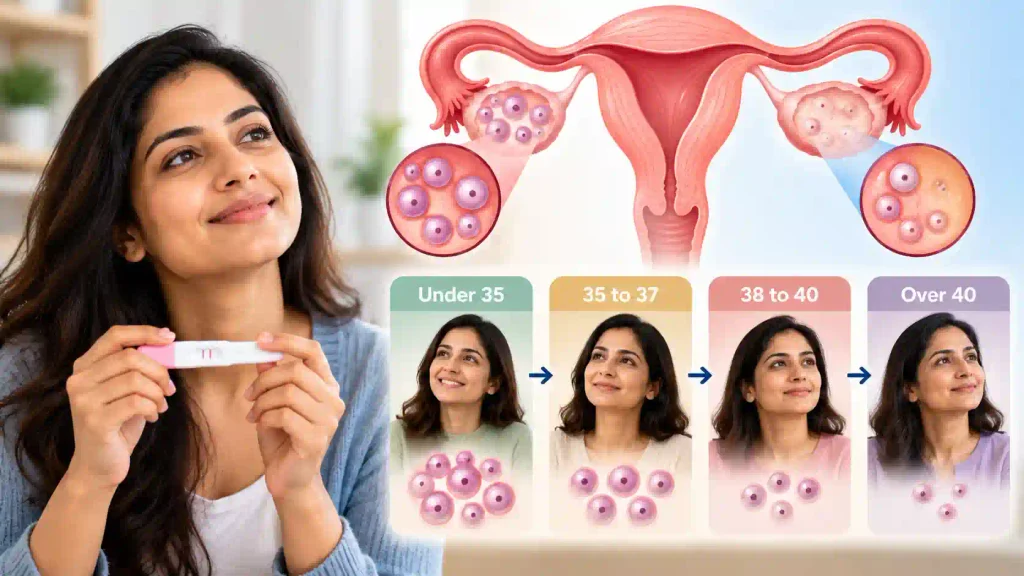
Chances by age band, stated honestly:
- Under 35: Natural conception with low AMH is common. Studies show pregnancy rates similar to women with normal AMH in this group.
- 35 to 37: Natural conception remains realistic. Monthly chances dip, so most doctors track progress more closely.
- 38 to 40: Still possible, but the window narrows each year. Early evaluation rather than early panic is the sensible move.
- Over 40: Natural pregnancy happens, yet monthly odds fall sharply, and IVF success with your own eggs drops to around 13 percent per retrieval at 41 to 42.
No study can hand you a personal percentage. Your tubes, ovulation, sperm health, and uterine health all share the stage with AMH.
Does Low AMH Affect Egg Quality?
Low AMH signals quantity, not quality. Egg quality depends mostly on age, because the proportion of eggs with abnormal chromosomes rises as you get older. A 33-year-old with an AMH of 0.6 generally has eggs of similar quality to a 33-year-old with an AMH of 3.0.
That distinction changes the strategy. With good quality but low numbers, the goal is to use the eggs you have efficiently. That means well-timed cycles, early diagnosis of any other issues, and no wasted years of unmonitored trying.
Low AMH but Regular Periods: What It Means
This combination confuses many women, and it is genuinely common. Regular periods usually mean you are still ovulating, which is the single most important requirement for natural conception. AMH can fall while ovulation continues normally for years.
Think of it this way. Periods tell you the machine still runs. AMH estimates how much fuel remains. A low fuel reading does not stop the engine today, but it is a fair reason to plan the journey wisely instead of assuming the tank is full.
Can Low AMH Cause Infertility?
Low AMH does not cause infertility the way blocked tubes or absent ovulation do. It lowers the odds that any single month works, mainly when reserve is very low or age has also advanced. Many women with low readings conceive without any help, and research on natural fertility shows age, not AMH, drives most of the decline.
Infertility is defined by time, not by a hormone value. If you have tried for a year under 35, or six months at 35 or older, without success, that is when evaluation begins. Some couples with low AMH who struggle to conceive are eventually found to have other factors, which is why a complete workup matters more than repeating the AMH test. Our research on unexplained infertility explains how we approach that situation.
What to Do If You Have Low AMH and Are Trying to Conceive
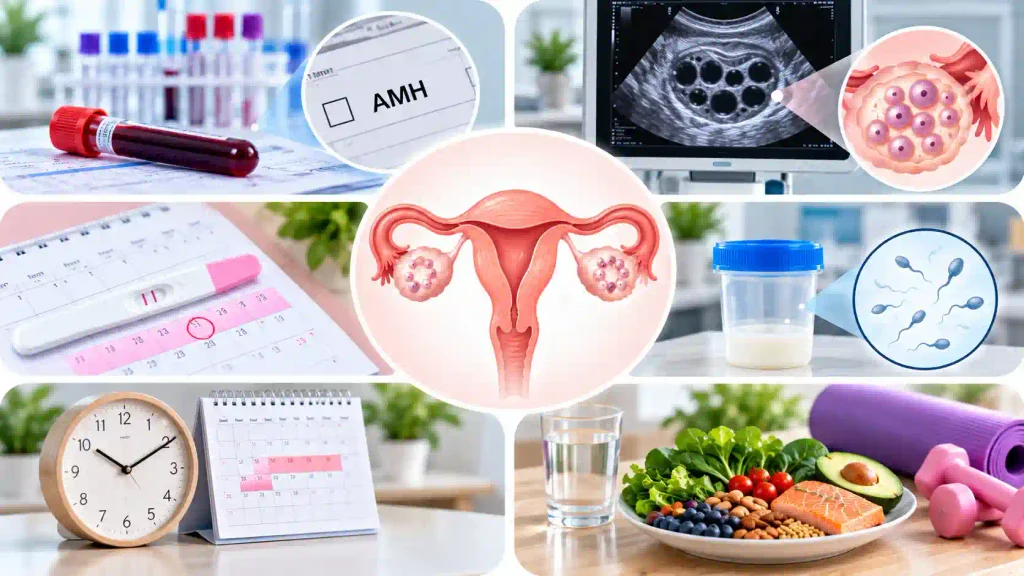
- Confirm the reading once. AMH varies slightly between labs and across your cycle, so a repeat test at a reliable lab prevents decisions based on noise.
- Add the rest of the picture. An antral follicle count on ultrasound, thyroid and prolactin levels, a partner’s semen analysis, and a check that ovulation is happening give the full story.
- Track ovulation. Ovulation predictor kits or simple cycle tracking confirm your most fertile days, because timing matters more with fewer eggs in play.
- Respect the clock. Under 35, try well-timed cycles for up to a year. At 35 or older, most specialists suggest a full check after six months.
- Protect general health. Sleep, a balanced diet, no smoking, and a healthy weight support fertility overall, even though none of these reliably raise AMH.
“If you are under 35, a few months of well-timed trying is completely reasonable before any testing. If you are 35 or older with low AMH, I usually suggest a full evaluation sooner, because time matters more than the number on that report.” Dr. Lakshmi Priya
Can AMH Levels Improve Naturally?
Short answer: not meaningfully. Egg count declines from before birth and cannot be restocked. Supplements such as DHEA and CoQ10 are heavily marketed, but strong evidence that they raise AMH or improve live birth rates is still missing. Lifestyle changes support your overall fertility and treatment response, so they are worth doing, just not as an AMH-raising strategy.
Low AMH Treatment Options
Treatment depends on your age, how long you have tried, and whether other factors show up on testing. The full medical workup is described on our fertility and infertility care, and our dedicated study to low AMH and poor ovarian reserve covers protocols in depth.
| Option | Best suited for | What it involves | Typical role with low AMH |
|---|---|---|---|
| Timed natural cycles | Under 35, trying under a year, tubes and sperm normal | Ovulation tracking and planned intercourse | Often the first, sensible step |
| IUI | Mild male factor, unexplained cases, or timed cycles not working | Prepared sperm placed into the uterus at ovulation; IUI treatment | Bridging option before IVF |
| IVF | Age 38+, very low AMH with time pressure, or other factors present | Stimulation, egg retrieval, and embryo transfer; see IVF treatment | May be advised earlier, with tailored doses |
Low reserve sometimes means adjusting IVF plans, such as higher medication doses, gentler mini-IVF cycles, or freezing embryos across more than one retrieval. Donor eggs remain an option for later, not a default.
“Low AMH changes the plan, not the goal. Sometimes the plan is patience with timed cycles, sometimes it is IVF with a stimulation tailored to your ovaries, and both are legitimate choices.” — Dr. Lakshmi Priya
Getting Pregnant After 35 with Low AMH
The combination of age and low reserve deserves a candid plan rather than reassurance or alarm. After 35, the priority is confirming everything else works: ovulation, tubes, uterus, and sperm. Once that is clear, many couples still conceive naturally within six months to a year.
The honest caveat is that monthly odds drift downward every year, and IVF outcomes fall with age even with normal AMH. That is why the recommendation shifts from “wait a year” to “check at six months.” Early information beats late regret, and acting early keeps more doors open, not fewer.
Can You Still Have a Healthy Pregnancy?
Yes. Women with diminished ovarian reserve who conceive have healthy pregnancies at rates similar to other women their age. The risks that matter, such as miscarriage and chromosomal concerns, track with age rather than with the AMH value itself. At least one in ten women faces some form of infertility, and most who conceive, with or without help, go on to deliver healthy babies.
Final Thought
A low AMH result is information, not a sentence. Read it alongside your age, your cycles, and your timeline, get a complete evaluation if you have been trying for a while, and choose the path that fits your family goals. Plenty of women with low readings become mothers, and the ones who do best are those who swapped panic for a plan. If you are in Bangalore and want that plan built around your numbers, book a consultation and we will map it together.
Frequently Asked Questions
1. Can you get pregnant naturally with low AMH?
Yes. Natural pregnancy happens regularly in women with low AMH, especially under 35. A large study found 84 percent of women with low AMH conceived within 12 months of trying without treatment.
2. What are the chances of natural pregnancy with low AMH?
Monthly chances depend more on age and ovulation than on AMH alone. Women under 35 with low AMH show conception rates close to women with normal levels, while odds decline steadily after 38.
3. Can you have regular periods and still have low AMH?
Yes, and it is common. Regular periods usually mean ovulation is happening, and AMH can be low while cycles stay normal for years. The reading signals a shrinking reserve, not a stopped system.
4. Does low AMH mean you cannot get pregnant?
No. Low AMH means fewer eggs remain, not that pregnancy is impossible. Cleveland Clinic notes AMH does not predict whether someone will conceive naturally.
5. Can low AMH cause infertility, or does it mainly indicate low egg reserve?
Low AMH mainly indicates a reduced egg count. It can lower monthly odds when very low, but it does not block conception the way blocked tubes or absent ovulation can.
6. Can you ovulate normally with low AMH?
Usually yes. Ovulation continues in most women with low AMH until reserve is nearly exhausted near menopause. Tracking cycles confirms ovulation is still occurring.
7. Does low AMH affect egg quality or only the number of eggs?
AMH reflects quantity. Egg quality is driven mainly by age, so a 32-year-old with low AMH generally has good-quality eggs, while the same reading at 41 carries age-related quality concerns.
8. What are the chances of getting pregnant with low AMH at 30, 35, or 40?
At 30, natural conception with low AMH is common and study rates match normal-AMH peers. At 35, chances remain reasonable with well-timed cycles. At 40, monthly odds drop sharply and earlier treatment discussions are fair.
9. Can you get pregnant after 35 with low AMH?
Yes, many women do. The key difference is timing: evaluation after six months of trying instead of twelve, because the fertile window narrows with each year.
10. How long should you try naturally if you have low AMH?
Under 35, standard guidance of up to 12 months applies, assuming tests show no other issues. At 35 or older, six months is the usual checkpoint before starting evaluation.
11. What should you do if you have low AMH but are trying to conceive?
Repeat the test once at a reliable lab, complete a full fertility workup including your partner’s semen analysis, and track ovulation for timed cycles. Then decide with your doctor based on age and timeline.
12. Can low AMH improve naturally, or can the AMH level be increased?
No method reliably raises AMH, since egg count cannot be restored. Supplements like DHEA and CoQ10 lack strong proof, and lifestyle changes support overall fertility without moving the number much.
13. What treatment options are available for low AMH and infertility?
Options include timed natural cycles, ovulation induction with IUI, and IVF with stimulation tailored to low-reserve ovaries. The right choice depends on age, how long you have tried, and other test findings.
14. When should you consider IVF or other fertility options with low AMH?
IVF is worth discussing early if you are over 38, if AMH is severely low with time pressure, or if timed cycles and IUI have not worked after a reasonable trial. Under 35 with no other issues, natural trying usually comes first.
15. Can women with diminished ovarian reserve still have a healthy pregnancy?
Yes. Once conception happens, pregnancy health depends mainly on age and general health, not on the AMH value. Women with low reserve carry pregnancies to term at rates similar to their peers.