



Most women who search for an ovarian reserve test in Bangalore are really asking about time. Maybe you plan to try for pregnancy at 33, or 38, or after years of putting your career first. Maybe a period arrived early this month and something felt different.
The truth is calmer than the online noise. Ovarian reserve testing is quick, widely available and fairly priced in this city. The catch is that each test answers a different question, and one number on a report sheet rarely tells the whole story.
I order these tests almost every week in my clinic. The results shape plans. They almost never justify panic. This page walks you through AMH, antral follicle count and FSH in plain language, so you can pick the right test, read your report with sense, and act with confidence.
Key Takeaways
- Ovarian reserve tests estimate how many eggs remain. None of them measure egg quality, and none predict by themselves whether you will conceive naturally.
- AMH is a blood test you can do on any day of your cycle, which makes it the most practical first step.
- AFC is a scan-based count of small resting follicles; counts below about 5 to 7 often suggest a low reserve.
- Day 2 FSH and estradiol add context, but both values swing from cycle to cycle.
- A JAMA study of 750 women aged 30 to 44 found that low AMH did not lower the chance of conceiving naturally within six months.
- Roughly 1 in 6 people worldwide face infertility at some point in life, so these questions are far more common than you think.
- An ovarian reserve test in Bangalore usually costs ₹800 to ₹2,800 for AMH, and a full panel with a scan often stays under ₹6,000.
What Is Ovarian Reserve, Really?
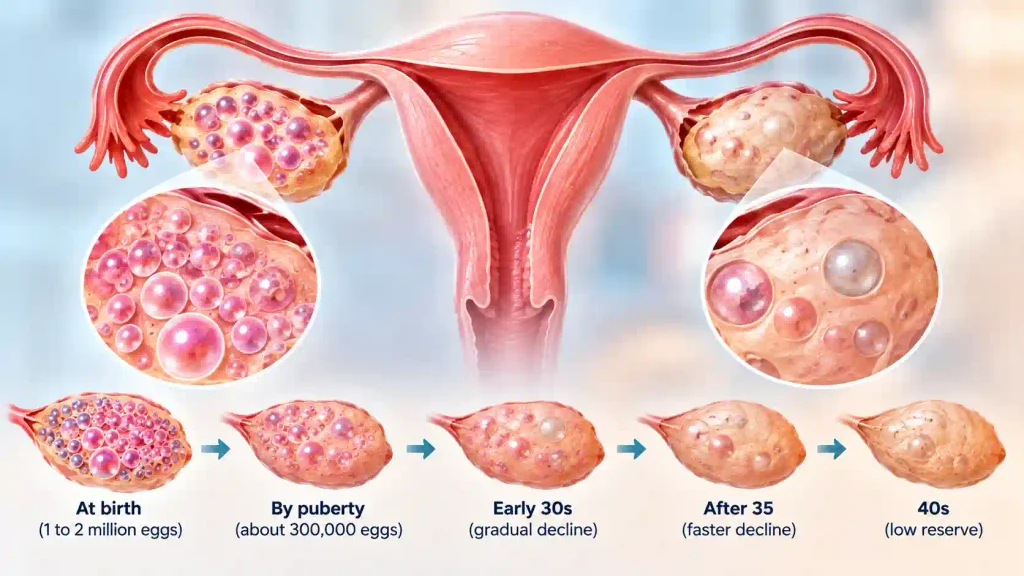
Ovarian reserve means the pool of eggs resting inside your ovaries. Every woman is born with all the eggs she will ever have, roughly 1 to 2 million. By puberty, about 300,000 remain. Only a few hundred are released over a lifetime; the rest fade away slowly.
Quantity falls with age. The decline is gentle through the early 30s and picks up pace after 35. Quality follows a similar path, and no blood test can read it directly.
“I explain it to patients this way. Ovarian reserve is a stock-take of supply, not a verdict on your fertility. A woman with a modest reserve can conceive on her own, and a woman with an excellent AMH can still face other hurdles. The test starts a conversation. It does not end one.” Dr. Lakshmi Priya
Doctors therefore combine test values, your age, cycle history and scan findings before drawing any conclusion.
The Tests, One by One
1. AMH: the blood test most clinics start with
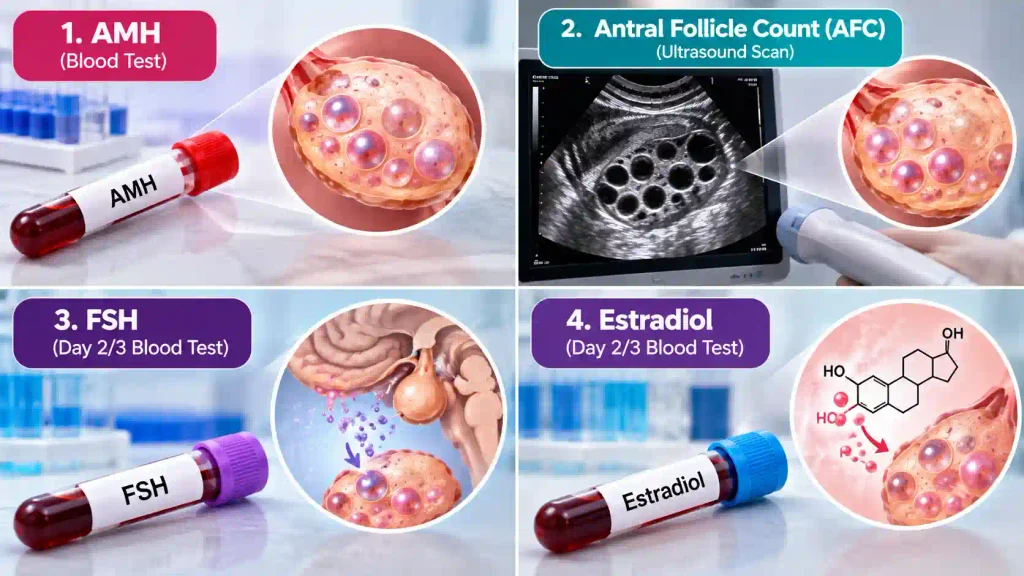
Anti-Müllerian hormone is released by small growing follicles in the ovaries. More follicles means more AMH, so the level roughly tracks the egg pool. This ovarian reserve blood test can be done on any cycle day, and many labs offer home collection, which makes it the easiest first step.
2. Antral follicle count: the scan that sees the supply
An antral follicle count (AFC) uses a transvaginal ultrasound in the first days of the cycle. The sonologist counts follicles of about 2 to 10 mm across both ovaries. The scan takes 10 to 15 minutes and gives a direct visual estimate of the resting egg pool.
3. Day 2 or day 3 FSH: the classic cycle-day test
FSH is the brain hormone that pushes the ovaries to work. When reserve falls, the brain pumps out more FSH. This fsh test fertility check must be drawn early, on day 2 or day 3, because levels shift sharply after that. Values above 10 mIU/mL raise a flag, though a normal FSH never fully rules out a low reserve.
4. Where estradiol fits in
Estradiol is usually checked on the same day 2/3 sample. An early rise in estradiol can push FSH down into the normal range, which hides a problem. If estradiol sits above roughly 60 to 80 pg/mL, most fertility doctors read the pair together instead of trusting FSH alone.
AMH vs AFC vs FSH: A Side by Side Look
| Test | What it measures | When it is done | What it tells you | What it cannot tell you |
|---|---|---|---|---|
| AMH | Hormone from small growing follicles | Any day of the cycle | Size of the egg pool; likely IVF response | Egg quality; your chance to conceive naturally |
| AFC | Count of 2 to 10 mm follicles on scan | Cycle days 2 to 5 | Resting follicle supply; how ovaries may respond to stimulation | Egg quality; whether tubes or uterus are normal |
| FSH (day 2/3) | Brain hormone driving the ovaries | Day 2 or 3 only | A high value suggests harder stimulation | A normal value does not prove reserve is fine |
| Estradiol (day 2/3) | Estrogen on the same sample | Day 2 or 3 only | Whether FSH is being falsely lowered | Anything on its own; it works only beside FSH |
No single winner exists. AMH is the easiest first step. AFC adds the visual proof. FSH and estradiol refine the picture when results conflict or treatment is being planned.
Which Test Matters When?
An ovarian reserve test in Bangalore is not one test but a small family of them. The right choice depends on where you stand today.
- Planning pregnancy but not trying yet: AMH gives the quickest read on supply, and it can be repeated yearly if you plan to wait.
- Irregular cycles or PCOS: AMH often reads high in PCOS, so it cannot be judged like a normal reserve value. Pair it with an AFC and specialist input, as covered in our study on PCOS and fertility.
- About to start IUI or IVF: clinics rely on AMH and AFC together to plan drug doses. This pairing is where these tests truly shine.
- Past ovarian surgery, endometriosis or chemotherapy: do both AMH and AFC early, since tissue loss can show up sooner than age alone would suggest.
- Age 38 or above and trying now: skip the waiting. Reserve testing helps, but a full check matters more than any single number.
If you are unsure where you fit, a comprehensive fertility evaluation looks at reserve alongside tubes, uterus, thyroid and partner factors in one plan.
Can You Trust the Numbers?
Before you book an ovarian reserve test in Bangalore, know what it can and cannot promise. These tests do one job well and another poorly. They predict how ovaries will respond to stimulation fairly well. They are weak at predicting whether conception will happen naturally in any given year.
The best evidence comes from the JAMA study mentioned above, which followed 750 women aged 30 to 44 with no history of infertility. Women with low AMH were just as likely to conceive within six cycles as women with normal values. Cleveland Clinic draws the same line: these tests predict treatment response, not the ability to get pregnant on your own.
“The most common mistake I see is treating AMH like a pregnancy fortune-teller. A low AMH tells me how I would plan a treatment cycle for you. It does not tell me that pregnancy is out of reach. I have watched women with sobering reports go on to have babies, and women with glowing reports who simply needed another piece of the puzzle solved.” Dr. Lakshmi Priya
Ask your doctor three things about any report: what the number means for planning, what it does not mean, and what the next step is. A trustworthy answer covers all three.
Signs of Declining Ovarian Reserve
Reserve rarely announces itself. Most women with a falling reserve feel completely normal, which is why testing matters when risk factors exist. Watch for these patterns:

- Cycles that have become shorter or less predictable than they used to be
- A mother or sister who reached menopause before 45
- Previous ovarian surgery, endometriosis, or treatment with chemotherapy or radiation
- Six months of trying without success after age 35, or a year before that
- Hot flushes, night sweats or missed periods before 40, which affect about 1 percent of women and need prompt attention
Any one of these is a reason for a simple check, not a reason to worry in advance.
Ovarian Reserve Test Cost in Bangalore
An ovarian reserve test in Bangalore is affordable, and you rarely need everything at once.
| Item | Typical price in Bangalore | Notes |
|---|---|---|
| AMH blood test | ₹800 to ₹2,800 | Varies by lab and assay; home collection often available |
| AFC ultrasound | ₹1,200 to ₹5,000 | Usually part of a transvaginal scan; confirm a follicle count is included |
| Day 2/3 FSH with estradiol | ₹200 to ₹800 per test | Timing matters more than price |
| Full fertility blood panel | ₹3,000 to ₹5,500 | Adds thyroid, prolactin and other hormones |
| Fertility specialist consultation | ₹500 to ₹2,000 | The reading of results is where the value lies |
Lab portals quote fixed rates, but the figure that matters is the cost of doing the right tests once, with someone qualified to interpret them.
Getting the Test Done in Bangalore: What to Expect
Getting an ovarian reserve test in Bangalore is simple once you know the sequence:
- Book with a fertility clinic rather than a standalone lab if you want results read in context, not just printed.
- Give the AMH sample on any cycle day; fast only if your clinic asks.
- Schedule the AFC scan between cycle days 2 and 5.
- Expect reports within 24 to 48 hours.
- Carry older reports, cycle dates and previous scan findings to the consult.
An experienced specialist can complete this round of fertility tests for women within a single cycle and discuss options within days. You can book a consultation to plan the order of tests around your dates.
If Your Results Come Back Low
Take a breath before you search “low AMH” at midnight. A low result is a planning signal, not a deadline. Options range from timed attempts to IVF treatment, and the right path depends on your age, how long you have been trying and partner factors.
Low AMH and poor ovarian reserve are conditions we manage routinely, with clear protocols for each stage. Many women in this situation conceive with their own eggs once the plan is tailored to them.
“Low reserve changes the timetable, not the destination. When I see a low number, my first job is to rule out what we can fix, then to help the couple choose a route that matches their goals. Time is the one resource we manage most carefully.” Dr. Lakshmi Priya
Final Thoughts
An ovarian reserve test in Bangalore is affordable, quick and genuinely useful when you match the test to the question. AMH tells you about supply. AFC shows it on screen. Day 2 FSH adds context when the picture needs refining. None of them, alone, decides your future.
Numbers on a report deserve context, and context is what a consultation provides. If something in your cycle or your plans has been nagging at you, book a visit, bring your questions, and let the tests serve your decisions rather than rule them.
Frequently Asked Questions
1. Which is better for ovarian reserve: AMH or AFC?
Both estimate the same egg pool from different angles, so they work best as a pair. AMH is easier and cycle independent, while AFC adds a direct scan view and catches cases AMH can miss. Most fertility doctors order both when treatment decisions are near.
2. Is AMH the best test for checking ovarian reserve?
AMH is the most convenient single test and the usual starting point. Still, no single marker is best, because AMH can mislead in PCOS, after ovarian surgery and in younger women. Your age and scan findings complete the picture.
3. What is an antral follicle count (AFC) in fertility testing?
AFC is the number of small 2 to 10 mm follicles seen on both ovaries during an early-cycle ultrasound. Each antral follicle holds one immature egg, so the total roughly reflects your resting supply. The scan takes about 10 to 15 minutes.
4. What is the difference between AMH, AFC and FSH tests?
AMH is a hormone blood test, AFC is an ultrasound count, and FSH is a brain hormone measured on day 2 or 3 of the cycle. AMH and AFC estimate the egg pool. FSH shows how hard the brain is working to drive the ovaries, which rises as reserve falls.
5. Can ovarian reserve tests tell me how many eggs I have left?
They give an estimate, not a headcount. A woman with 100,000 eggs and a woman with 30,000 can show similar AMH values. These tests rank supply within your age group far better than they count eggs precisely.
6. What is a normal AMH and AFC range for my age?
For most adult women, AMH between 1 and 3 ng/mL is typical, and values under 1 ng/mL are considered low. For AFC, counts between about 5 and 20 are usually reassuring, while below 5 to 7 raises concern. Labs differ, so your doctor reads the value against your age, not a single chart.
7. Why is FSH tested on day 2 or day 3 of the menstrual cycle?
Early in the cycle, before a follicle has been chosen, FSH reflects the true effort the brain is making. After day 3, rising estrogen pulls FSH down and masks the signal. Day 2 or 3 gives the cleanest reading.
8. Does estradiol affect the results of an FSH fertility test?
Yes. An early estradiol rise can suppress FSH into the normal range and hide a low reserve. If estradiol is above about 60 to 80 pg/mL, a normal FSH is not accepted at face value. Both hormones are read together.
9. Can I have a normal AMH but still have fertility problems?
Yes, and it happens often. AMH says nothing about tube patency, ovulation timing, sperm parameters or uterine factors, all of which matter equally. Normal AMH with unsuccessful trying means the search should move to these other causes, not stop.
10. What are the signs of declining ovarian reserve?
Most often there are none, which is exactly why testing exists. When signs appear, they tend to be shorter cycles, lighter or changed flow, and difficulty conceiving after months of trying. Family history of early menopause and prior ovarian surgery raise the odds.
11. How accurate are ovarian reserve tests?
They are reliable at ranking reserve and predicting IVF response, and unreliable at predicting natural conception month to month. Values also swing between cycles, especially FSH. Consistent trends carry more meaning than one isolated reading.
12. At what age should I consider ovarian reserve testing?
From around 30 if you have risk factors such as endometriosis, ovarian surgery or a family history of early menopause. Without risk factors, testing around 32 to 35 helps if you plan to delay pregnancy. After 38, test early, because time carries more weight.
13. If my ovarian reserve is low, can I still get pregnant naturally?
Yes, many women with low AMH or low AFC conceive without treatment. The JAMA study cited above found natural conception rates held steady even with low AMH in women under 45. Low reserve calls for less waiting between reviews, not for despair.
14. How is an ovarian reserve test done in Bangalore?
The usual route is an AMH blood draw at a clinic or lab, plus a transvaginal ultrasound between cycle days 2 and 5 for the AFC. Most labs return AMH results within 24 to 48 hours. A fertility consultation then ties the numbers to your plan.
15. How much does an ovarian reserve test cost in Bangalore?
An AMH test runs about ₹800 to ₹2,800 depending on the lab. The AFC scan adds roughly ₹1,200 to ₹5,000, and day 2/3 FSH with estradiol stays under ₹1,000. A complete panel with a scan and consult generally fits within ₹6,000 to ₹8,000.