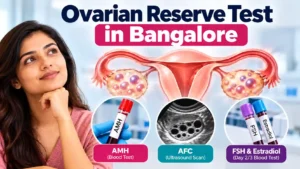


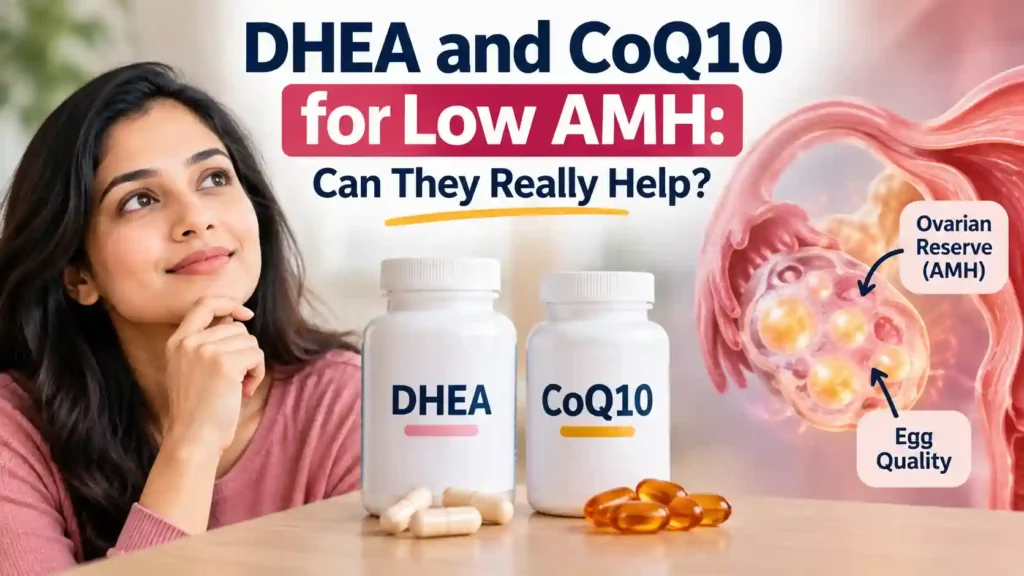
You searched your AMH result online, read the number, and felt your stomach drop. Then you found three fertility supplements with five-star reviews, a promise of “younger eggs,” and a checkout button. If you are wondering whether DHEA and CoQ10 for low AMH are genuine science or clever marketing, you are asking exactly the right question.
I have this conversation in my clinic almost every week. Patients arrive with supplement receipts and a folder of Google printouts, hoping a bottle can rewind their biological clock. The honest answer is more nuanced than most product pages admit, and it matters, because roughly 1 in 6 adults worldwide face infertility, and none of them can afford to waste precious months on the wrong things.
Key Takeaways
- DHEA is a hormone precursor, not a vitamin. Studies in women with poor ovarian response used 75 mg daily for 8 to 12 weeks before IVF, not casual self-supplementation.
- The 2024 Cochrane review of 28 trials in 3,002 women found DHEA pre-treatment likely makes little to no difference to live birth rates in poor responders, so the benefit, if any, is modest at best.
- CoQ10 supports energy production inside eggs. One randomized trial of 169 young women with reduced reserve found 600 mg daily for 60 days nearly doubled median eggs retrieved (4 vs 2) and improved fertilization rates (67.5% vs 45.1%).
- An improved egg count or lab measure is not the same as a proven higher chance of taking a baby home. That distinction is the heart of this debate.
- DHEA has real hormonal side effects and should never be taken with PCOS, pregnancy, or hormone-sensitive conditions without specialist supervision.
- Supplements are a supporting act, never the main treatment. Evaluation and time-sensitive planning matter far more than any capsule.
What Low AMH Actually Means for Your Eggs
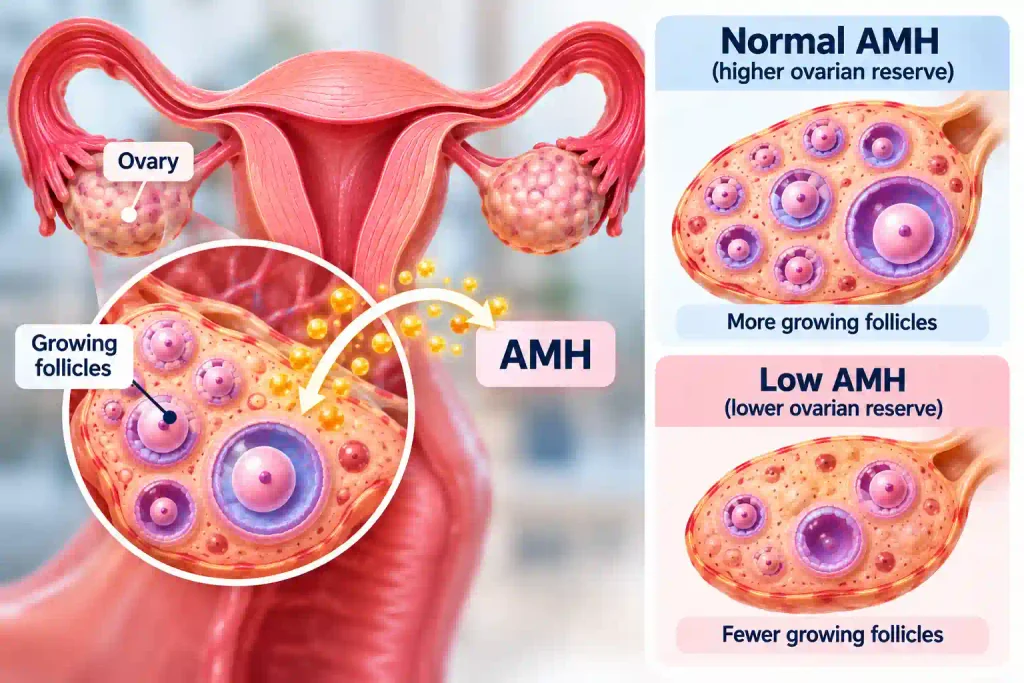
Anti-Müllerian hormone is produced by small growing follicles in your ovaries, so it works as a rough headcount of your remaining egg supply. A low AMH suggests fewer eggs are waiting in the queue compared with other women your age.
Two misconceptions cause most of the panic I see in consultation. First, AMH predicts how many eggs you will retrieve in an IVF cycle far better than it predicts whether you will conceive naturally. Women with low AMH get pregnant; the monthly odds are simply smaller, not zero. Second, AMH says nothing about egg quality. Quality is driven mainly by age and the health of each egg’s energy factories, called mitochondria, and this is precisely where CoQ10 theory enters the story.
“A low AMH number is a planning tool, not a verdict. It tells me how to design your stimulation protocol, not whether you will ever hold your baby.” Dr. Lakshmi Priya
The Evidence on DHEA for Fertility
1. Where the enthusiasm started
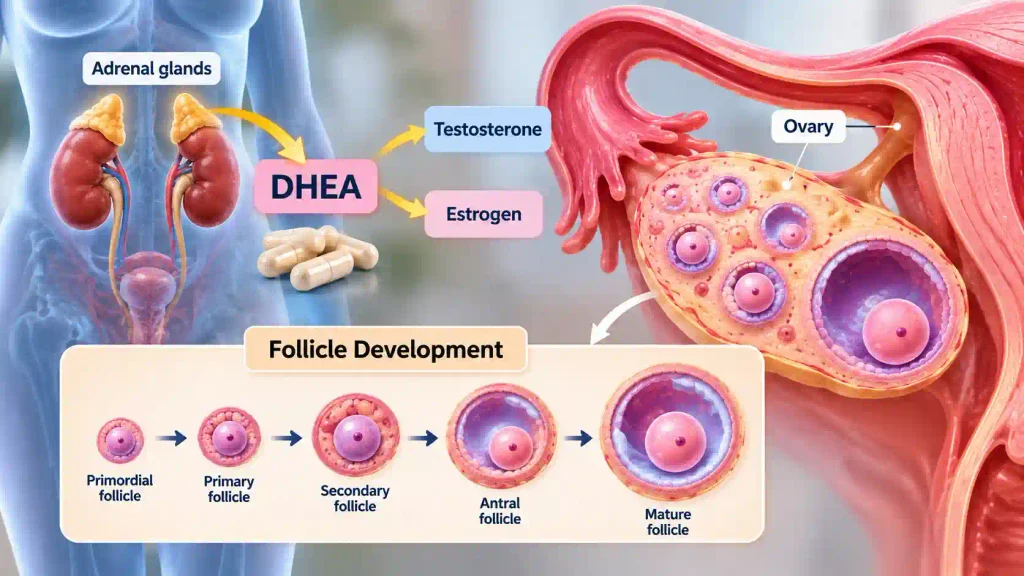
DHEA is a weak male-type hormone your adrenal glands already produce, and it converts into both testosterone and estrogen. The theory is appealing: androgens appear to stimulate early follicle growth, so topping up might enlarge the pool of eggs available for stimulation. Early observational studies from Cornell reported more retrieved eggs and better embryo grades after DHEA use, and a small randomized trial (Wiser 2010, just 33 women) reported live birth rates of 23.1% with DHEA versus 4% without.
Fertility clinics took notice, and DHEA became a near-ritual for poor responders. The regimen used in research was typically 75 mg daily (often 25 mg three times a day) for at least 8 to 12 weeks before starting IVF. Clinics like CNY Fertility still recommend starting 6 to 8 weeks ahead of a cycle.
2. What the strongest evidence now says
When researchers pooled all 28 randomized trials involving 3,002 women, the picture sobered considerably. The 2024 Cochrane review concluded that DHEA pre-treatment likely results in little to no difference in live birth or clinical pregnancy rates for women identified as poor responders. Where a comparison group had a 12% chance of success, the DHEA group’s estimated chance ranged from 12% to 20% with real uncertainty around it.
| Claim you will read online | What the evidence supports |
|---|---|
| “DHEA adds eggs to your ovarian reserve” | Not supported. It may modestly improve response to stimulation drugs in some women. It cannot create new eggs. |
| “It raises AMH, so your reserve improved” | AMH may tick up, but this marker shift has not been shown to translate into more live births. |
| “It doubles pregnancy rates” | Based on one tiny trial of 33 women. Pooled data across 1,433 women showed no certain benefit. |
| “Completely safe because it is natural” | False. It is an active hormone with real side effects and contraindications. |
3. DHEA side effects and who should avoid it
Because DHEA is hormonal, its side effects are hormonal too: acne, oily skin, hair loss on the scalp, facial hair growth, deeper voice changes, mood swings, and stomach upset. It can lower HDL cholesterol and affect insulin. Harvard Health advises avoiding DHEA entirely during pregnancy and breastfeeding, with liver problems, and in PCOS, and warns it can worsen hormone-sensitive conditions such as breast or ovarian cancer and endometriosis.
“In my practice I never prescribe DHEA blind. If a patient has PCOS features, acne flaring, or any hormone-sensitive history, the risks can easily outweigh a benefit that is already uncertain. Hormones are not harmless just because a label says supplement.” Dr. Lakshmi Priya
For many women with PCOS and low AMH, this single point changes the whole conversation, which is why I address it early in getting pregnant with PCOS planning.
The Evidence on CoQ10 for Egg Quality
CoQ10 works by an entirely different route. Every cell uses mitochondria to produce energy, and eggs are among the most energy-hungry cells in your body. CoQ10 sits inside the mitochondrial energy chain and also acts as an antioxidant. The hypothesis: aging eggs run low on CoQ10, energy output falls, chromosomes separate badly during division, and quality drops. Replenishing CoQ10 might support the energy supply.
The trial that gets quoted most often is genuinely encouraging, within its limits. Xu and colleagues randomized 169 young women with reduced ovarian reserve before IVF. Those taking 600 mg daily of CoQ10 for 60 days had a median of 4 eggs retrieved versus 2 in controls, fertilization rates of 67.5% versus 45.1%, and more high-quality embryos. A smaller pilot in women aged 35 to 43 suggested a lower rate of chromosomally abnormal embryos, though with only 39 participants it could not prove a live-birth benefit.
Read those endpoints carefully. More eggs, better fertilization, better embryos: yes, in selected groups. A proven increase in babies born: not yet demonstrated. CoQ10 is also generally well tolerated, with occasional insomnia, headaches, or digestive upset, and it can interact with warfarin and some diabetes medications.
DHEA and CoQ10 Together: Smart Combo or Double Spend?
Many protocols combine both, on the logic that DHEA recruits more follicles while CoQ10 powers up the eggs those follicles release. The combination has been studied in small trials with promising lab findings, but no large, high-quality trial has shown that taking both beats taking neither for live birth.
Practically, I see three sensible positions:
| Your situation | Reasonable approach |
|---|---|
| Under 35, low AMH, preparing for IVF | CoQ10 has the stronger safety-to-evidence balance; discuss DHEA only if your specialist expects a poor response |
| Over 38 with low AMH | Time matters more than supplements; full evaluation first, supplements only alongside a plan |
| PCOS, hormone-sensitive condition, or unexplained cycles | DHEA is usually the wrong tool; CoQ10 may still have a role after review |
Dr. Lakshmi Priya says: “CoQ10 is the supplement I am most comfortable discussing, because its side-effect profile is gentle and its mechanism is plausible. DHEA is the one I want to control, because you are adding a hormone to a system that may already be sensitive.”
How Long Before IVF Should You Start?
Eggs spend roughly three months maturing before ovulation or retrieval, so any supplement needs a similar runway. The studies that showed anything used at least 60 days of pre-treatment, which is why I ask patients to decide before their planning cycle rather than the week before stimulation.
The stronger point is the reverse: do not let supplement hunting delay treatment. Ovarian reserve does not wait politely while you trial brands. If your specialist has already advised IVF or fertility preservation, start that conversation now, and let supplements run alongside it if you both agree they fit.
Other Supplements Worth Discussing
- Myo-inositol: Reasonable evidence in PCOS for improving ovulation and insulin sensitivity, which is why it features prominently in PCOS care rather than in low AMH care.
- Vitamin D: Deficiency is common in India and is linked with worse IVF outcomes in observational studies. Test and correct a deficiency; do not megadose on assumption.
- Folate and a standard prenatal: Non-negotiable basics before any pregnancy, with or without IVF.
- The rest of the “egg quality” aisle: Melatonin, omega-3s, and a long list of expensive blends have thin fertility-specific evidence despite confident packaging.
One review of 39 fertility supplements found most manufacturers lacked solid scientific backing for their pregnancy claims. Quality control is a genuine problem, because supplements are not tested like medicines. Buy from brands with third-party testing, and tell your doctor everything you take, since interactions go both ways.
How to Decide, Practically
- Get a full evaluation first. AMH alone never tells the whole story, and comprehensive fertility evaluation often finds treatable factors that matter more than any supplement.
- Ask your specialist two direct questions: “Given my age and reserve, is DHEA likely to help my specific protocol?” and “What would you take yourself in my position?”
- If you and your doctor agree to try, use studied doses, start 8 to 12 weeks out, and stop DHEA once pregnant.
- Track what actually counts: eggs retrieved, fertilization, embryo quality, and ultimately transfer outcomes, not a rising AMH on a repeat blood test.
- If you are planning IVF in Bangalore and feel pressured to buy a supplement stack you were never properly assessed for, treat that as a reason to seek a second opinion, not a reason to open your wallet.
Anyone considering these options deserves a clear picture of where they sit in low AMH and poor ovarian reserve treatment, because supplements are one small lever among several.
Final Thought
DHEA and CoQ10 for low AMH sit in the honest middle ground: not miracle cures, not useless. CoQ10 has the gentler safety profile and the more coherent science around egg energy. DHEA carries real hormonal risks for a benefit that large pooled evidence calls uncertain at best. Neither replaces evaluation, sound protocol design, or timely decisions. Bring your supplement list to your next appointment rather than your next paycheck to a website, and let evidence, not marketing, set your plan.
Frequently Asked Questions
1. Can DHEA and CoQ10 really help with low AMH?
They can help in specific, limited ways. CoQ10 improved egg numbers and fertilization in a randomized trial of young women with reduced reserve, while DHEA’s benefit on live birth is uncertain per the largest evidence review. Neither restores ovarian reserve or reverses age-related egg loss.
2. Does DHEA increase AMH levels?
Some studies show modest AMH rises on DHEA, yes. The problem is that a higher AMH number has not been shown to equal more live births, so treating the number itself is a trap. I care about your cycle outcomes far more than a rechecked AMH.
3. Can CoQ10 improve egg quality with low AMH?
CoQ10 supports mitochondrial energy in eggs, and one good trial showed better egg retrieval and fertilization in young women with reduced reserve. “Improve egg quality” in the sense of guaranteed better embryos or babies is not yet proven. It is promising, not proven.
4. Can you take DHEA and CoQ10 together for fertility?
Physically, yes, and combined protocols exist. The evidence that the combination beats either alone, or beats nothing, is thin. If you take both, do it under supervision with a clear review point rather than indefinitely.
5. What is the recommended DHEA dosage for fertility?
Studies used 75 mg daily, usually 25 mg three times a day, for 8 to 12 weeks before IVF. That is a study regimen, not a self-prescription. Doses should be individualized, because the same milligrams affect a PCOS patient and a poor responder very differently.
6. What is the right CoQ10 dosage for IVF?
The clearest trial used 600 mg daily for 60 days before stimulation. Common clinical practice ranges from 200 to 600 mg daily, often as ubiquinol for better absorption. Confirm the dose and brand with your specialist rather than guessing.
7. How long should you take DHEA and CoQ10 before IVF?
Plan on at least two months, ideally three, since eggs mature over roughly 90 days. Starting a week before your cycle helps nothing except the seller’s quarterly figures. Build it into your planning timeline, not your stimulation timeline.
8. Is DHEA safe for women with low AMH?
It can be used safely in selected women under monitoring, but it is not automatically safe. Harvard Health advises against it in pregnancy, liver disease, and PCOS, and warns about hormone-sensitive conditions. Safe use means the right patient, the right dose, and someone watching.
9. What are the common DHEA side effects when used for fertility?
Expect possible acne, oily skin, scalp hair loss, facial hair, mood changes, and stomach upset, and it can lower good cholesterol. Most are dose-related and reversible on stopping. Any virilizing change, like deepening voice, should prompt immediate discontinuation and review.
10. Should you take DHEA before IVF if you have low AMH?
Only if your specialist expects a poor response and your profile suits it, because pooled evidence shows little certain live-birth benefit. It is a legitimate discussion for planned poor responders, not a default. For many women, optimizing the protocol matters more than the supplement.
11. Is ubiquinol better than CoQ10 for egg quality?
Ubiquinol is the pre-converted, active form and is absorbed better, especially over age 40. No head-to-head fertility trial proves one form produces better eggs than the other. If absorption is the worry, ubiquinol is a reasonable choice at an equivalent effective dose.
12. What are the best supplements for improving egg quality?
The shortlist with actual trial support is CoQ10, vitamin D correction where deficient, folate, and omega-3s, with myo-inositol if PCOS is present. Nothing on any shelf outranks not smoking, adequate sleep, and weight management. Supplements polish; lifestyle decides.
13. Can myo-inositol help women with low AMH?
Myo-inositol’s best evidence is in PCOS, where it improves ovulation and insulin sensitivity. For low AMH without PCOS, the data are weak and inconsistent. I suggest it when there are PCOS features, not purely because an AMH is low.
14. Can vitamin D help improve fertility when AMH is low?
Correcting a deficiency is worthwhile, since low vitamin D has been associated with poorer IVF outcomes in observational research. That is different from claiming extra vitamin D raises AMH or egg quality in replete women. Test, correct if needed, then retest rather than megadosing.
15. Which supplements may support ovarian reserve and egg quality in low AMH?
Realistically, CoQ10 for egg energy, vitamin D for deficiency, folate and a prenatal for basics, and myo-inositol for PCOS cases. DHEA sits in a supervised-decision category because of its hormone effects. No supplement has been shown to increase true ovarian reserve, so protect your time and get assessed early.