



You have been trying for a baby for months. Every month brings hope, then quiet disappointment. Now you are thinking about seeing a fertility specialist in Bangalore, but you are not sure what happens in that room.
That uncertainty stops many couples from booking. The first visit is simpler than most people imagine. It is a calm, unhurried conversation, a few basic checks and a clear plan for what comes next.
The sections below walk you through the visit, from when to book to what happens after.
Key Takeaways
- Infertility is common. About one in six people worldwide face infertility, which WHO defines as not achieving pregnancy after 12 months or more of regular unprotected sex.
- It affects every region. Lifetime prevalence was 17.8% in high-income countries and 16.5% in low and middle-income countries.
- Most couples conceive within a year. Around 84% of couples conceive naturally within a year when they have regular sex every 2 or 3 days. About half of the rest conceive in the second year.
- Age changes the timeline. The CDC advises women aged 35 and older to seek evaluation after six months, and Mayo Clinic notes testing may start right away after 40.
- Men matter equally. A male factor alone causes difficulty in about 30% of couples and combines with a female factor in another 20%, so it plays a part in roughly half of all cases.
- Not every test is needed. Most people do not need all, or even many, infertility tests, and you and your care team decide which ones you have and when.
- Sometimes no cause is found. Finding the cause can take several tests, and in some cases a cause is never identified. Treatment can still help.
When to See a Fertility Specialist in Bangalore
Knowing when to see a fertility specialist saves time, stress and money. A simple rule works well for most couples.
- Under 35: Book after 12 months of regular, unprotected sex.
- 35 to 39: Book after 6 months of trying.
- 40 or older: Book now. Do not wait.
Some couples should come sooner, whatever their age:
- Periods that are irregular, very painful or absent
- Known PCOS, endometriosis, fibroids or thyroid problems
- Two or more miscarriages
- Past pelvic infection, surgery or cancer treatment
- A male partner with known sperm problems, past testicular surgery or erection concerns
“Many couples tell me they waited because their periods were regular. Regular cycles are a good sign, but they do not check the tubes, the uterus or the sperm. A simple evaluation gives you answers instead of guesses.” — Dr. Lakshmi Priya
Preparing for Your Fertility Appointment
Good preparation turns a first fertility consultation into a productive one. You leave with a plan, not just a list of tests.
1. What to Bring
- Dates of your last 3 to 6 periods (a period app is fine)
- All previous scan, blood test and semen analysis reports
- Records of any past IUI, IVF or fertility medicines
- Surgery notes, such as laparoscopy or hysteroscopy reports
- A list of current medicines and supplements for both partners
- Your written questions
2. Which Day of Your Cycle to Book
You can book a first visit on any day. Your doctor will then time some tests to your cycle:
- Day 2 to 5 of your period: Baseline hormone tests and an ovarian scan
- Around day 10 to 14: Follicle tracking scans to check ovulation
- After your period ends, before ovulation: Tests for tube openness, such as HSG
If your visit falls on day 2 to 5, some tests may be done the same day. That can save you an extra trip.
3. Tips for the Male Partner
A semen analysis usually needs 2 to 5 days without ejaculation before the sample. Ask the clinic for exact instructions when booking.
What Happens During Your First Fertility Consultation
Most first visits take 30 to 60 minutes. Nothing painful or rushed should happen without your consent.
1. A Detailed Conversation
Your doctor will ask about:
- How long you have been trying and how often you have sex
- Your period pattern, pain and flow
- Past pregnancies, miscarriages or terminations
- Medical conditions, surgeries and medicines
- Lifestyle factors such as smoking, alcohol, weight, sleep and work stress
These questions are personal. Honest answers help your doctor find the right path faster, and everything stays confidential.
2. A Gentle Physical Examination
For women, this may include weight, BMI, blood pressure and a pelvic examination. A transvaginal ultrasound is common because it shows the uterus and ovaries clearly. It may feel a little uncomfortable, but it should not hurt.
For men, a general check may be done, and a specialist may examine the testes if needed.
3. A Personalised Test Plan
Your doctor then explains which tests make sense for you. Some are done on the same day, and others are timed to your cycle. A full fertility evaluation builds a complete picture of both partners.
“The first visit is not about deciding on treatment. It is about understanding your body and your story. When couples know why each test matters, the process feels far less overwhelming.” — Dr. Lakshmi Priya
Fertility Tests for Couples
A proper fertility workup looks at both partners together. Fertility is a shared story, and testing only one person wastes valuable time. You can read more about shared fertility concerns.
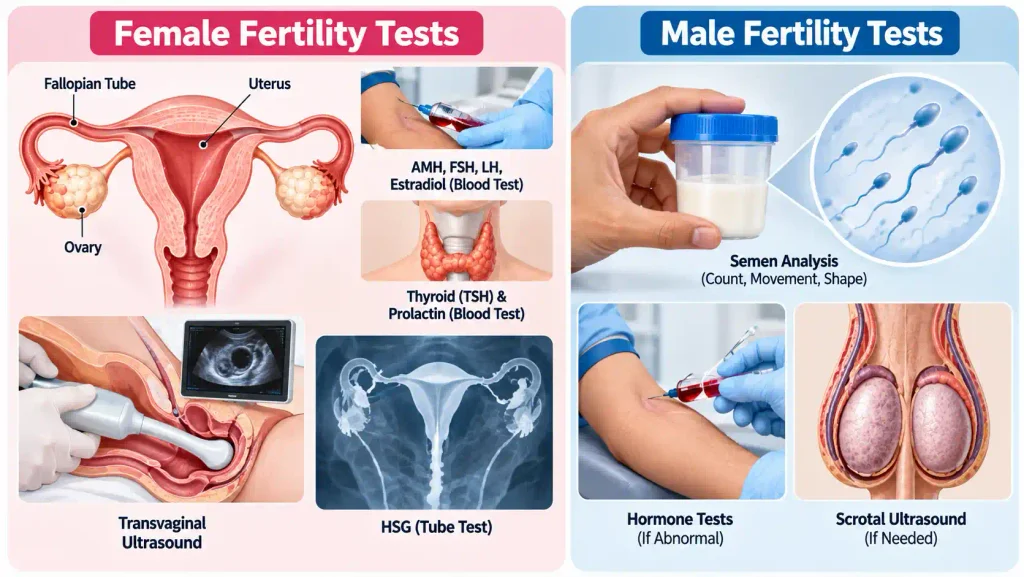
1. Female Fertility Checkup
- AMH blood test: Estimates egg reserve
- Day 2 to 5 hormones: FSH, LH and estradiol
- Thyroid (TSH) and prolactin: Common hidden causes of ovulation problems
- Transvaginal ultrasound: Checks the uterus, ovaries and antral follicle count
- HSG or sono-HSG: Checks whether the fallopian tubes are open
- Other tests as needed: Blood sugar, vitamin D, rubella immunity
2. Male Fertility Test
- Semen analysis: Checks sperm count, movement and shape
- Hormone tests: Done if the semen report is abnormal
- Further tests: Repeat analysis, scrotal scan or DNA fragmentation, only when needed
Male testing deserves equal attention. According to Mayo Clinic data, an abnormal male factor contributes in about half of all infertile couples. A semen analysis is simple, quick and affordable.
Comparing Female and Male Tests
| Test | Who | What It Shows | When It Is Done |
|---|---|---|---|
| AMH | Woman | Egg reserve | Any day |
| FSH, LH, estradiol | Woman | Ovary function | Day 2 to 5 |
| Transvaginal ultrasound | Woman | Uterus, ovaries, follicles | Day 2 to 5, or any day |
| HSG / sono-HSG | Woman | Open fallopian tubes | After period, before ovulation |
| Thyroid, prolactin | Woman | Hormone balance | Any day |
| Semen analysis | Man | Count, motility, shape | After 2 to 5 days of abstinence |
| Male hormones | Man | Sperm production signals | Only if semen report is abnormal |
Will You Be Told to Start IVF?
Almost never at the first visit. A good IVF doctor in Bangalore will not suggest IVF until test results are ready and simpler options have been weighed.
| Option | Who It Usually Suits | How Involved It Is |
|---|---|---|
| Lifestyle changes and timed intercourse | Young couples, normal tests | Low |
| Ovulation medicines | PCOS or irregular ovulation | Low |
| IUI treatment | Mild sperm issues, unexplained infertility | Moderate |
| Laparoscopy or hysteroscopy | Endometriosis, fibroids, polyps, blocked tubes | Moderate |
| IVF or ICSI | Blocked tubes, low egg reserve, severe sperm problems | High |
“IVF is a wonderful option when it is truly needed, but it is not the starting point for everyone. Many couples conceive with simpler, less expensive treatment once we find the real cause.” — Dr. Lakshmi Priya
Questions to Ask Your Fertility Doctor
Write these down and bring them along:
- What tests do we both need, and why?
- What might cause our difficulty, based on what you see so far?
- What treatment options suit us, and what are the success rates for our age?
- How many visits will the next month involve?
- What will the tests and treatment cost?
- What can we change at home to improve our chances?
- When should we come back?
Fertility Consultation Cost in Bangalore
Fertility consultation cost in Bangalore varies by clinic, doctor experience and location. The consultation fee is usually separate from tests and scans.
To avoid surprises:
- Ask for the consultation fee when booking.
- Ask for a written, itemised estimate for tests.
- Check whether your insurance covers diagnostic tests.
- Ask if partner testing can be done on the same day.
A clear doctor will discuss costs openly. If a clinic will not share prices, treat that as a warning sign.
How to Choose the Best Fertility Doctor in Bangalore
The best fertility doctor in Bangalore for you is the one who explains, listens and plans with you. Look for:

- A qualified gynaecologist for infertility with specialist fertility training
- A clinic that tests both partners from the start
- In-house ultrasound and lab support, which saves trips
- Honest talk about success rates and costs
- No pressure to start IVF at the first visit
- A doctor you feel comfortable asking anything
A trusted fertility clinic in Bangalore should feel like a partnership, not a sales counter.
What Happens After Your First Fertility Evaluation
Once results are ready, you return for a review visit. Your doctor explains each result in plain words and suggests a plan.
- A clear cause is found: Treatment targets that cause directly.
- Results look normal: This is called unexplained infertility. Options range from timed intercourse to IUI and, later, IVF.
- Your plan is reviewed: Progress is checked every few cycles and adjusted if needed.
Final Thoughts
Booking your first appointment is often the hardest step. Once you are in the room, the visit becomes a calm conversation, a few simple checks and a plan you understand.
You do not need to have everything figured out. You only need to bring your reports, your questions and your partner.
If you have been trying for a while, an early evaluation can save months of worry.Book your consultation with Dr. Lakshmi Priya and take the first clear step towards parenthood.
Frequently Asked Questions
1. When should you see a fertility specialist in Bangalore if you are trying to conceive?
See a fertility specialist after 12 months of trying if you are under 35, or after 6 months if you are 35 or older. If you are 40 or older, book straight away. Come sooner if you have irregular periods, PCOS, endometriosis, past miscarriages or known sperm concerns.
2. What happens during the first fertility consultation for a couple?
Your doctor takes a detailed history of both partners, covering periods, past pregnancies, health conditions and lifestyle. A physical exam and ultrasound may follow. You leave with a personalised test plan and a clear idea of the next steps.
3. Should both partners visit a fertility specialist for the first appointment?
Yes, ideally both partners should attend. Male factors play a part in about half of all cases, so testing both of you early saves time. Coming together also helps you understand the plan and support each other.
4. What tests can a fertility specialist recommend during the first consultation?
Common first tests include AMH, day 2 to 5 hormones, thyroid and prolactin, and a transvaginal ultrasound for the woman. The man is usually asked for a semen analysis. A tube test such as HSG may be added later, timed to the cycle.
5. Do I need to bring previous medical reports to my first fertility appointment?
Yes, please bring every report you have, including scans, blood tests, semen reports and treatment records. These help your doctor avoid repeating tests unnecessarily. They also show how things have changed over time.
6. Will I need an ultrasound or blood tests on my first visit to a fertility clinic in Bangalore?
Often, yes. A transvaginal ultrasound is commonly done at the first visit because it gives quick, useful information. Blood tests may be drawn the same day or timed to day 2 to 5 of your next cycle.
7. What fertility tests are recommended for women and men before starting treatment?
Women usually need AMH, hormone tests, thyroid checks, an ultrasound and a tube test. Men need at least one semen analysis, with hormone tests if results are abnormal. Your doctor tailors the list to your history, so not everyone needs every test.
8. Can I consult a fertility specialist if my periods are regular but I am not getting pregnant?
Absolutely. Regular periods usually mean you ovulate, but they do not confirm open tubes, a healthy uterus or normal sperm. Endometriosis and male factor problems can exist even when cycles are perfectly regular.
9. Will a fertility doctor recommend IVF at the first consultation, or are there other options?
IVF is rarely suggested at the first visit, because the cause has to be understood first. Many couples do well with lifestyle changes, ovulation medicines, IUI or minor surgery. IVF is advised when tests show it offers the best chance.
10. How much does a first fertility consultation cost in Bangalore?
Costs vary by clinic, doctor and location, and the consultation fee is usually separate from tests. Ask for the fee when you book and request an itemised estimate for tests. Our team shares costs upfront so you can plan without surprises.
11. What questions should I ask a fertility specialist during my first appointment?
Ask which tests you both need and why, what the possible causes are and what treatment options suit your age. Also ask about costs, the timeline and lifestyle changes. Writing questions down beforehand helps you remember them in the moment.
12. Should I book my fertility consultation on a specific day of my menstrual cycle?
You can book your first visit on any day. Booking on day 2 to 5 of your period is helpful, though, because baseline hormone tests and scans can be done the same day. Your doctor will schedule the other tests around your cycle.
13. Can a fertility specialist identify the cause of infertility in the first visit?
Sometimes a likely cause shows up quickly, such as PCOS on a scan. Most couples, however, need test results before a clear answer is possible. A review visit after testing usually gives a much fuller picture.
14. How do I choose the best fertility doctor in Bangalore for my situation?
Choose a doctor who tests both partners, explains results clearly and discusses costs honestly. Look for proper specialist training and on-site scan and lab support. Most importantly, pick someone who listens and never rushes you into treatment.
15. What happens after the first fertility evaluation if no clear cause of infertility is found?
This is called unexplained infertility, and it is more common than many people think. Treatment often starts with timed intercourse or ovulation support, then moves to IUI and, if needed, IVF. Many couples with unexplained infertility do go on to conceive.